

Above: The Big House Museum in Macon, Georgia. Image courtesy of Visit Macon
The Big House: A Century of History, Music and Mystery in Macon
Long before it became one of the most important destinations in Southern rock history, The Big House in Macon, Georgia, was already a remarkable home.
Its stained-glass windows, numerous fireplaces, spacious rooms, third-floor ballroom, and landscaped grounds reflected the elegance of Vineville at the beginning of the twentieth century.
Through the decades, the property at 2321 Vineville Avenue changed owners, residents, and purposes. It served as a private residence, became the communal home of members of the Allman Brothers Band and their extended family, returned to private and professional use, housed another emerging band during an important rehearsal period, and eventually became a museum visited by music fans from around the world.
The house has also inspired another kind of interest.
Former residents and visitors have described footsteps, misplaced objects, unusual encounters near the staircase, and other experiences they could not readily explain. Those accounts eventually brought the Macon Beyond team inside the historic property to explore what might remain when the music stops and the house grows quiet.
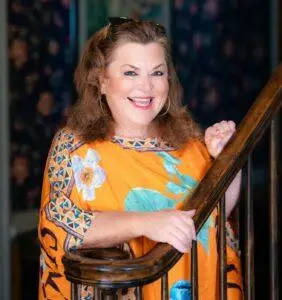
For Joanna “JoJo” Jones, a lifelong Macon resident, The Big House represents something larger than a single period in music history.
It is an example of how one Macon property can hold the stories of successive generations—and how thoughtful preservation can give an irreplaceable home an entirely new future.
This is the story of the house itself: what it was before the Allman Brothers arrived, what happened after they left, and how a private Vineville residence became one of Macon’s most recognized cultural landmarks.
The Big House is remembered as the home of the Allman Brothers Band, but the property’s complete story reaches across more than a century of Macon history.
A Grand Home on Vineville Avenue
The Big House stands at 2321 Vineville Avenue, approximately two miles northwest of downtown Macon.
When the house was constructed around the beginning of the twentieth century, Vineville was already developing into one of Macon’s most prominent residential areas.
Vineville had begun much earlier as a landscape of farms, estates, and large tracts outside the original city center. As Macon expanded, the area became home to business owners, attorneys, physicians, political figures, and families who built residences reflecting their position in the community.
The neighborhood developed gradually rather than during a single building campaign. As a result, its streets contain an unusually rich collection of nineteenth- and twentieth-century architecture.
The Big House emerged within that evolving residential landscape.
The building is generally described as a large Tudor Revival residence. The style became popular in the United States during the late nineteenth and early twentieth centuries, drawing inspiration from medieval and early English architecture while adapting it for modern American homes.
Although the house is now inseparable from its musical identity, its scale and architectural character originally announced something very different: permanence, prosperity, gracious living, and the formal social customs of an earlier Macon.
Was The Big House Built in 1900 or 1904?
Published histories do not agree on the house’s exact construction year.
The official history provided by The Big House Museum says the residence was constructed in 1900. Current property information and several published museum features also use that year.
The official Visit Macon page accompanying the Macon Beyond investigation dates the house to 1904.
That difference may reflect an estimated construction date, a later completion or alteration, an early property record, or a story passed through successive owners.
Older houses frequently present this kind of challenge. Deeds document ownership of land but do not always establish precisely when every structure was completed. Tax records, city directories, architectural surveys, building permits, family papers, and newspaper advertisements may each preserve only part of the story.
For that reason, the most historically responsible description is that The Big House was constructed around the turn of the twentieth century, most commonly dated to 1900, although some accounts use 1904.
A House With More Than One Historical Date
Using both dates with proper context does not weaken the house’s history. It recognizes that responsible preservation includes identifying what the surviving record establishes—and what remains open to further research.
Inside the Original Residence
The house encompasses approximately 4,442 square feet and has traditionally been described as containing 18 rooms across three principal levels.
Its interior includes high ceilings, French doors, stained-glass windows, multiple fireplaces, generous bedrooms, formal gathering spaces, and details that would have made the house one of Vineville Avenue’s notable residences.
Outside, a double lot provided room for gardens, fountains, mature plantings, and a fishpond.
One of the most intriguing original spaces was the large room on the third floor. According to the museum’s history, it was designed as a ballroom when the house was constructed.
Smaller rooms adjoining that space reportedly served as bedrooms and play areas for two daughters of a former owner. Family recollections preserved by the museum describe that owner as a military man whose travels contributed antiques and decorative objects from different parts of the world.
When later residents entered previously locked rooms on the third floor, they reportedly found an upright piano, a claw-foot table, and other stored furnishings and objects.
The names and complete ownership history of the house’s earliest residents are not clearly established in publicly available accounts. That gap is an important part of the story rather than an invitation to fill the record with assumption.
What can be seen in the surviving architecture is that the property was built for family life, entertaining, and gathering long before musicians began filling its rooms.
The Changing Life of a Historic Property
Historic houses rarely remain unchanged.
Families grow, owners move, neighborhoods evolve, and buildings are altered to serve new generations. Rooms created for one purpose become bedrooms, offices, studios, storage areas, or gathering spaces for people the original occupants could never have imagined.
The Big House followed that pattern.
By 1969, the property was vacant and being offered for rent through Day Realty. Its formal rooms, extensive grounds, and numerous bedrooms presented an unusual opportunity—but maintaining such a large residence required people willing to share both the space and the expense.
That opportunity arrived at precisely the moment a young band and its extended family needed somewhere larger to live.
Linda Oakley Finds the House
In late 1969, Berry Oakley’s wife, Linda Oakley, was living with Berry, their infant daughter Brittany, and Berry’s sister Candy in a cramped one-bedroom loft above an apartment occupied by drummer Butch Trucks.
The Allman Brothers Band was away on its first tour through the western United States when Linda began searching for a larger home.
Linda, Candy Oakley, and Donna Allman saw an advertisement for the Vineville Avenue property and went to view it.
They discovered a large, light-filled house surrounded by gardens, wisteria, fountains, and a fishpond. Inside were spacious rooms, fireplaces, stained glass, French doors, and enough room to create both private family quarters and shared gathering spaces.
Three couples could contribute toward the rent, making Day Realty’s monthly price of $225 seem possible.
In December 1969, Linda approached the agency and presented herself as a responsible young mother looking for a suitable family home. The rental was secured, and by January 1970 the residents were beginning to move in.
The Allman Brothers Band did not purchase the house, as some abbreviated retellings suggest. Linda Oakley rented it, and the women connected with the band played a central role in turning it into a home.
Who Lived at The Big House?
The first household included Berry and Linda Oakley and their daughter Brittany; Duane and Donna Allman and their daughter Galadrielle; Candy Oakley; and Gregg Allman, who was then in a relationship with Candy.
Different parts of the house became associated with individual families.
Candy and Gregg occupied the large front bedroom with its own fireplace and bathroom. Duane and Donna used a bedroom at the opposite end of the house, with an adjoining room serving as Galadrielle’s nursery. Berry, Linda, and Brittany occupied rooms toward the rear.
Others stayed for shorter periods.
Road manager Willie Perkins initially slept in the living room. Roadie Kim Payne later lived in the house with Candy Oakley. Donna’s sister Joan and Allman Brothers roadie Mike Callahan also stayed there.
Dickey Betts was not necessarily a permanent resident, but the museum reports that he frequently slept on a pullout sofa in the parlor with his girlfriend, Sandy “Blue Sky” Wabegijig.
Road crew members, relatives, musicians, friends, and people associated with Capricorn Records moved through the property as well.
The Big House was therefore more than a residence shared by musicians. It was the center of an extended family whose lives were intertwined with the rapid emergence of the Allman Brothers Band.
The Women and Children Who Made It a Home
Because the musicians spent so much time touring, Linda Oakley remembered the women and children as the house’s most consistent residents.
They created a domestic refuge to which the band could return, giving The Big House a family life that existed alongside its music, visitors, celebrations, and disorder.
A House Reimagined From Room to Room
The new residents did not erase the house’s earlier character. They adapted it.
Linda and Berry transformed a rear room into a retreat known as the Casbah. Indian-print fabrics covered the walls, a carefully chosen stereo filled the room with music, and the original stained-glass windows added color and atmosphere.
The kitchen became a place for meals, conversation, and songwriting. The living room accommodated friends and overnight guests. Bedrooms provided private family areas within an otherwise communal household.
The children’s footsteps echoed through the halls. Miles Davis might play during a quiet breakfast. When the band returned from touring, the character of the house changed as reunions, visitors, parties, rehearsals, and informal performances filled its rooms.
At one early gathering, the extended family reportedly met in the music room to celebrate and divide one of the band’s first meaningful royalty checks.
That moment reflected the communal philosophy surrounding the band during its formative years. Music was important, but so were family, shared responsibility, and the belief that success belonged to the larger group.
The Music Written Inside the House
Several rooms became associated with songs that would eventually reach audiences around the world.
Dickey Betts reportedly wrote “Ramblin’ Man” in the kitchen and “Blue Sky” in the living room. Gregg Allman worked on material including “Please Call Home,” “Ain’t Wastin’ Time No More,” “Leave My Blues at Home,” and “Midnight Rider” while connected with the household.
The room now interpreted as the Fillmore East Room was used for rehearsing and playing music.
The house was not a commercial recording studio. Its importance came from the less formal work that surrounds recorded music: writing, listening, practicing, exchanging ideas, returning from the road, and living among people who shared the same ambitions.
The complete story of the band’s arrival in Macon, its performances, relationship with Capricorn Records, influential albums, and lasting role in Southern rock is explored in our companion article, The Allman Brothers Legacy in Macon, GA.
Together, the two stories reveal the relationship between the people and the place: one follows the musicians who helped change American music, while this one follows the Macon house that received them.
A Home Touched by Triumph and Loss
The Big House witnessed the band’s growing success, but it also became inseparable from two devastating losses.
By October 1971, Duane Allman was no longer living at the house full time. On October 29, however, he returned with flowers as preparations were being made for Linda Oakley’s birthday and Halloween.
He helped carve a jack-o’-lantern before leaving on his motorcycle. He never returned.
Duane died after a motorcycle accident in Macon at only 24 years old.
A little more than a year later, on November 11, 1972, Berry Oakley was fatally injured in another motorcycle accident.
The losses changed the emotional life of the household as profoundly as they changed the band.
By early 1973, the communal period at The Big House had ended. The remaining residents left, and the property began another chapter without the family that had given it the name by which it would become famous.
What Happened After the Allman Brothers Left?
The two decades following the band’s departure are among the least thoroughly documented periods in the house’s published history.
Available accounts indicate that the property changed hands and was adapted to different uses. At various times it reportedly functioned as a private residence, a beauty salon, and a law office.
The complete sequence of owners and occupants is not identified in the museum’s public history.
That absence illustrates an important truth about historic preservation. A famous chapter does not automatically preserve everything that happened before or afterward.
The ownership of land may survive in courthouse deeds, while the everyday lives lived inside a property may remain scattered through city directories, tax records, newspaper advertisements, photographs, letters, and family memories.
Although more archival work may eventually fill those gaps, the house remained standing through this quieter period—waiting for people who understood what it had represented to Macon and to music history.
Kirk and Kirsten West Come Home
In August 1993, longtime Allman Brothers Band road manager, archivist, and photographer Kirk West and his wife, Kirsten West, purchased The Big House.
Their original vision was to restore the property and operate it as a bed-and-breakfast where music fans could stay inside one of the places most closely connected to the band.
After moving to Macon, they discovered that zoning would not permit the proposed use. The property instead became their private home.
Kirk’s extensive collection of Allman Brothers Band photographs, recordings, documents, posters, memorabilia, and archival material gradually occupied more of the house.
Visitors came from across the country and beyond. For many fans, being invited inside offered something unavailable at a conventional exhibit: the opportunity to enter the rooms where part of the band’s history had actually unfolded.
Kirsten lived in the house for approximately 14 years. Her experience connected its past as a private home with its eventual future as a public museum.
Gov’t Mule Rehearses at The Big House
The house’s role in music did not end when the Allman Brothers household dispersed.
In June 1994, Warren Haynes, Allen Woody, and Matt Abts brought their instruments and equipment into rooms at The Big House.
For eight days, they rehearsed there before leaving to perform the first shows by Gov’t Mule.
The moment created a remarkable connection across generations.
More than 20 years after the original Allman Brothers family left the property, another influential band prepared for its beginning inside the same house.
The gathering place on Vineville Avenue had become musically active once again.
A Musical Story That Continued
Gov’t Mule’s 1994 rehearsals demonstrate that The Big House was not preserved merely as the setting of something that had ended.
Its rooms continued to provide a place where musicians gathered, prepared, and began something new.
From Private Residence to Preservation Mission
By the early 2000s, the question was no longer whether The Big House mattered. The question was how it could be preserved permanently.
Kirk and Kirsten had welcomed fans, maintained the property, and assembled an extraordinary archive, but converting a large historic residence into a public museum required an organization, funding, restoration work, professional planning, and community support.
When the Wests considered selling the property, supporters proposed creating a charitable foundation that could acquire the house and preserve its connection to the Allman Brothers Band and Middle Georgia’s musical heritage.
The effort developed into The Big House Foundation.
Public property information records a sale on October 19, 2007, for $500,000. The acquisition allowed the Foundation to move forward with the work of transforming a private residence into a museum.
That transformation required more than placing memorabilia in rooms.
The building had to be repaired, interpreted, adapted for visitors, and protected without removing the residential character that made it historically meaningful.
The result needed to function as both an archive and a historic house—preserving objects while also preserving a sense of place.
The Museum Opens Its Doors
On December 5, 2009, The Allman Brothers Band Museum at The Big House opened to the public.
The museum is now described as holding the world’s largest collection of Allman Brothers Band memorabilia.
Its exhibits include instruments, handwritten materials, concert posters, photographs, clothing, gold records, personal possessions, recordings, film material, original artwork, and objects connected with the band’s extended family and road crew.
Equally important, visitors experience those objects inside the rooms where part of the story occurred.
The parlor presents concert posters and records. The Fillmore East Room recalls the space where the original band rehearsed. Brittany Oakley’s bedroom contains childhood objects, including her original dollhouse and the dress she wore in a photograph used on the back of the Brothers and Sisters album.
The Casbah recreates the household’s private music retreat. The roadie room recognizes the crew members whose work sustained the band. The kitchen connects visitors with “Ramblin’ Man” and includes an original table from H&H Soul Food.
Other spaces document changing band lineups, individual members, performances, tours, recordings, artwork, and the larger community that formed around the music.
The museum succeeds because it does not separate the artifacts from their human setting. Visitors are not simply viewing objects associated with famous musicians. They are walking through a house where adults raised children, friends slept on sofas, meals were shared, songs developed, careers changed, and devastating news arrived at the door.
Is The Big House Haunted?
The Big House has accumulated stories that do not fit neatly into a deed record, architectural description, or museum inventory.
Former residents and visitors have reported footsteps when no visible person was nearby, objects disappearing and later returning, unusual activity around the staircase, and the impression that someone unseen was moving through the house.
Kirsten West has described unexplained experiences from her years living on the property, including encounters associated with a young-girl presence that became familiar to people inside the home.
Other accounts have raised the possibility that something in the house appeared to imitate or mimic the sounds of its living residents.
These reports do not constitute scientific proof of paranormal activity.
Old houses can produce unfamiliar sounds. Staircases shift, wood contracts, plumbing and mechanical systems activate, and sound travels through rooms in unexpected ways. A museum also contains objects carrying powerful personal and emotional associations, which can influence how visitors experience the space.
Yet ordinary explanations do not always resolve what a particular witness believes occurred.
The significance of these accounts lies not in forcing every reader to accept one conclusion, but in recognizing that personal testimony and folklore have become part of the property’s modern history.
History, Memory and the Unexplained
The house’s architecture, ownership, residents, music, and preservation can be investigated through historical evidence.
Reports of unexplained activity remain matters of personal experience, interpretation, investigation, and belief.
Macon Beyond Investigates The Big House
In 2024, Macon Beyond brought viewers inside The Big House to examine the intersection of history, memory, creative energy, and reported paranormal activity.
The destination storytelling series was created through a partnership involving Visit Macon and actor and producer Carrie Genzel.
The Big House episode features host Carrie Genzel, investigator Jonathan Morgan, empath and medium Morrighan Lynne, and longtime resident and Allman Brothers archivist Kirk West.
The episode begins with the house’s early history and follows its evolution through changing occupants until Linda Oakley discovered the vacant property in 1969.
From there, it considers whether the atmosphere reported inside the home predates the Allman Brothers period and whether a place capable of inspiring such intense creativity might retain impressions of the people and emotions that passed through it.
That question is intentionally open-ended.
Creativity cannot be measured as paranormal energy, and investigative equipment cannot establish the identity of an unseen presence. The team’s observations, intuitive impressions, historical information, and recorded anomalies instead invite viewers to examine the house from several perspectives.
The investigation also changes how the audience sees the museum.
During normal visiting hours, The Big House is filled with music, photographs, artifacts, conversation, and fans moving from room to room.
After dark, the same rooms become still. The staircase, bedrooms, Casbah, ballroom, hallways, and former gathering spaces take on a different character.
Every sound becomes more noticeable. Every movement invites closer attention. The house is no longer experienced only as a museum exhibition but as an old residence that sheltered many lives before the public ever entered it.
Viewers may interpret what happens as paranormal activity, environmental effects, intuition, coincidence, or experiences that remain unexplained.
Whatever conclusion they reach, the episode accomplishes something important: it encourages people to look beyond the famous name associated with the address and consider the full life of the property.
The investigation presents The Big House not simply as a container for music history, but as a historic Macon home shaped by every generation that entered its doors.
Watch the complete episode through Macon Beyond: Exploring the Awe-Inspiring Big House in Macon, Georgia.
Why Preserving The Big House Matters
Without preservation, The Big House could have become another historic property remembered primarily through old photographs and stories.
Its survival allows visitors to understand history spatially.
They can stand in the kitchen where conversations and songs developed, look through the stained glass of the Casbah, enter rooms once occupied by young families, and recognize that nationally important music emerged from an ordinary pattern of daily life.
Preservation also protects more than the building’s connection to celebrities.
The house contributes to the architectural character of Vineville, supports Macon’s identity as a center of American music, and provides a physical link between the city’s residential history and the creative movement surrounding Capricorn Records.
Its continued operation introduces visitors to other Macon landmarks, including H&H Soul Food, Capricorn Sound Studios, Grant’s Lounge, Rose Hill Cemetery, and the broader collection of neighborhoods and historic buildings that distinguish the city.
One preserved property can therefore help sustain an entire network of local history.
The Big House and Macon’s Cultural Economy
People travel to Macon from across the United States and around the world because of its music history.
When they visit The Big House, they also encounter the city surrounding it.
They dine in local restaurants, stay in area hotels, explore downtown, visit other museums, attend performances, and travel through neighborhoods they may never have known otherwise.
Programs such as Macon Beyond extend that reach by introducing the city’s historic places to people before they arrive.
A viewer who begins with an interest in music or unexplained history may discover Macon’s architecture, restaurants, neighborhoods, museums, and expanding cultural life.
Cultural attractions do not determine a real estate market by themselves, but they contribute to something buyers value deeply: a sense of place.
People are drawn to communities with recognizable identities, preserved landmarks, meaningful stories, and experiences unavailable anywhere else.
The Big House could not be separated from Macon and placed in another city without losing much of its meaning. Its value comes from where it stands, the people who passed through it, and the larger musical and cultural landscape around it.
A Landmark That Introduces People to Macon
The Big House attracts visitors through music history, but the experience can become an introduction to Macon itself.
That connection supports local tourism while helping people understand why Macon’s history and character remain valuable to those who live here.
The Big House and JoJo’s Macon
JoJo’s understanding of Macon began long before she entered real estate.
She grew up here and has experienced the city through its neighborhoods, historic properties, local traditions, cultural landmarks, and generations of people who have made Middle Georgia home.
The Big House reflects the kind of history that makes Macon distinctive.
It began as an impressive private residence. It adapted as owners and occupants changed. It experienced periods of activity and uncertainty. Ultimately, people recognized that its architecture and stories were too important to lose.
That history also illustrates why a property cannot always be understood through square footage, bedrooms, acreage, or a sales record alone.
Homes acquire meaning through the lives lived inside them.
Most will never become museums, but every established Macon home participates in the history of its street, neighborhood, and community.
Understanding that larger setting helps buyers recognize what makes one location different from another—and helps sellers communicate the character and value of the place they have called home.
Experience The Big House Museum
Photographs can show the exterior of The Big House, and recordings can preserve the music associated with it.
A visit brings the two together.
Walk through the rooms and notice the architectural details that existed before the band arrived. Look at the stained-glass windows, fireplaces, staircase, French doors, and third-floor space.
Then consider how dramatically the meaning of those rooms changed after 1970.
A formal residence became a communal home. A kitchen became part of songwriting history. A private retreat became the Casbah. Bedrooms became museum exhibits. An archival collection that once filled a family home became a public resource.
The Big House is meaningful because those different lives remain visible together.
Its architecture tells one story. Its artifacts tell another. The recollections of former residents add personal detail, while the questions explored by Macon Beyond invite visitors to consider whether every impression within the house can be explained.
More than a century after its construction, The Big House remains what it has been for generations: a place where people gather, listen, remember, and feel connected to something larger than themselves.
Plan Your Visit to The Big House Museum
Explore the historic rooms, photographs, instruments, recordings, clothing, artwork, and personal objects preserving the story of the Allman Brothers Band and the people surrounding them.
Review current admission information, operating hours, exhibits, accessibility details, events, and visitor policies through the official Big House Museum website.
Planning to Visit or Move to Macon?
Whether you are planning a visit, considering a move, or already calling Middle Georgia home, places such as The Big House reveal the history, creativity, and sense of community that make Macon distinctive.
Joanna “JoJo” Jones understands that buying a home also means choosing a community.
Having grown up in Macon, JoJo brings a lifelong connection to the city and an understanding of the neighborhoods, landmarks, traditions, and changes that have shaped it.
From historic residences and established neighborhoods to growing communities, cultural attractions, restaurants, music, and local events, JoJo helps buyers discover more than available properties.
She helps them understand what it can mean to become part of Macon.
If you are considering buying or selling a home in Macon or Middle Georgia, contact JoJo to begin your next chapter.
New Listings: Macon Georgia
Sign up: Market Reports
Learn More: About JoJo
View More: Macon Listings
Featured: Macon Magazine
JoJo's Properties: JoJo's Listings Hub
Contact Me: Sell Smart with JoJo™