
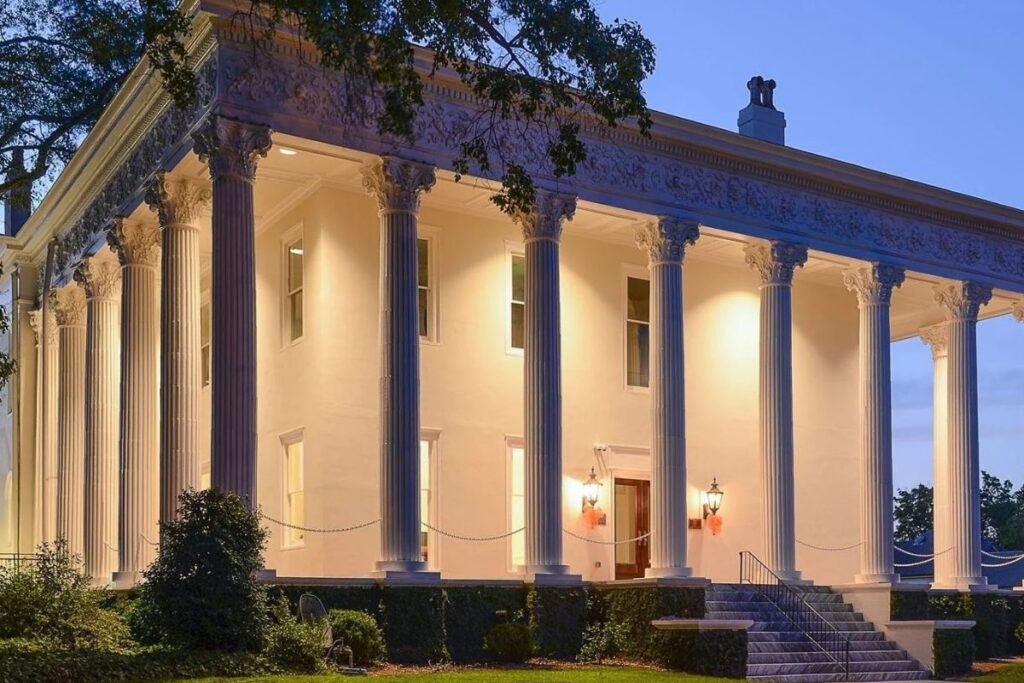
Featured image courtesy of
Visit Macon.
MACON & MIDDLE GEORGIA • HISTORIC HOMES & ARCHITECTURAL HERITAGE
Historic Homes of Macon & Middle Georgia
The Legendary Mansions, Remarkable Families & Architecture That Shaped a Region
A HISTORICAL FEATURE BY JOANNA “JOJO” JONES
Sheridan Solomon & Associates • Macon, Georgia
There are houses that provide shelter, houses that become family heirlooms, and houses that become part of history.
Throughout Macon and Middle Georgia, magnificent residences have survived generations of change. Some were built by merchants whose businesses helped shape the city’s economy. Others were commissioned by railroad financiers, judges, industrialists, political leaders, and families who brought European architectural influences to the American South.
Some have witnessed wars. Others have welcomed celebrated writers and musicians. Still others have been carefully restored after decades of neglect, preserving an architectural identity that might otherwise have disappeared.
Behind the stately columns, elaborate staircases, stained-glass windows, and sweeping verandas are remarkable human stories. These homes reflect ambition, prosperity, craftsmanship, creativity, and the changing character of the region in which they were built.
Yet their importance extends beyond the past. Today, Macon’s historic neighborhoods, distinctive architecture, and established communities contribute to a residential landscape that attracts buyers with many different goals.
From beautifully restored Victorian houses to Craftsman bungalows and historic cottages with renovation potential, Middle Georgia offers an extraordinary variety of places to call home.
For prospective homeowners and investors, the region’s architectural heritage provides an appealing combination of character, neighborhood identity, and opportunities for thoughtful long-term ownership. This comprehensive journey explores the famous historic homes of Macon and surrounding Middle Georgia communities, introduces the people behind these remarkable buildings, and explains why the region’s residential heritage continues to matter in today’s real estate market.
THE STORY BEHIND THE ADDRESS
“A historic home is more than an architectural treasure. It is a chapter of human history, preserved in brick, wood, stone, and memory.”
PART ONE • THE BEGINNING OF A CITY
How Macon Became a City of Extraordinary Homes
Macon was incorporated in 1823 along the Ocmulgee River, in a region with a much deeper history as a center of Indigenous life. The surrounding area has a long history that includes the Muscogee (Creek) people and centuries of settlement before Macon’s nineteenth-century growth.
The river, regional agriculture, transportation networks, and the arrival of railroads helped Macon grow into an important commercial center. Cotton became especially important to its economy, connecting local merchants and planters to national and international markets.
Much of the wealth that financed antebellum architecture emerged from the Southern agricultural economy, where cotton production, trade, and commerce played central roles in the region’s prosperity. The construction of these remarkable homes also depended upon skilled builders, artisans, and laborers, whose contributions helped shape the architectural heritage of Macon and Middle Georgia.
As Macon expanded, affluent residents commissioned houses along prominent streets and elevations near the central business district. Georgia Avenue, College Street, and surrounding neighborhoods became showcases for the architectural fashions of their time.
Over the decades, Macon evolved beyond its nineteenth-century commercial roots. Residential growth extended into Vineville, Ingleside, Shirley Hills, and other neighborhoods, creating a remarkable collection of architectural styles representing different generations of homebuilding.
Today, Macon-Bibb County contains thousands of historic buildings within National Register historic districts. This architectural diversity is one of the qualities that distinguishes Macon’s residential real estate from many communities dominated by more recent construction.
An Architectural Vocabulary of Middle Georgia
Federal: Balanced facades, refined proportions, and restrained classical decoration associated with the early nineteenth century.
Greek Revival: Temple-like columns, substantial porticos, symmetrical designs, and classical details.
Italianate and Italian Renaissance Revival: Decorative brackets, arched windows, towers, elaborate interiors, and inspiration from Italian architecture.
Queen Anne and Victorian: Asymmetrical facades, turrets, ornamental woodwork, stained glass, varied rooflines, and expressive design.
Beaux-Arts and Neoclassical Revival: Formal compositions, classical ornament, grand staircases, imposing entrances, and monumental details.
Craftsman: Broad porches, exposed rafters, substantial masonry supports, natural materials, and practical arrangements.
Tudor and Colonial Revival: Historical interpretations incorporating steep gables, decorative half-timbering, brickwork, and traditional American classical details.
PART TWO • THE GREAT MANSIONS OF MACON
The Landmark Residences That Defined a City
From sophisticated European-inspired estates to inventive Greek Revival masterpieces, these residences represent some of Macon’s most recognizable architectural achievements.
01 / THE PALACE OF THE SOUTH
Hay House: William Butler Johnston’s Extraordinary Vision
Few historic residences in Georgia rival the ambition of Macon’s Johnston–Felton–Hay House, better known simply as Hay House.
Constructed between 1855 and 1859 for William Butler Johnston and his wife, Anne Tracy Johnston, this approximately 18,000-square-foot mansion was inspired by the couple’s extended travels through Europe during the early 1850s.
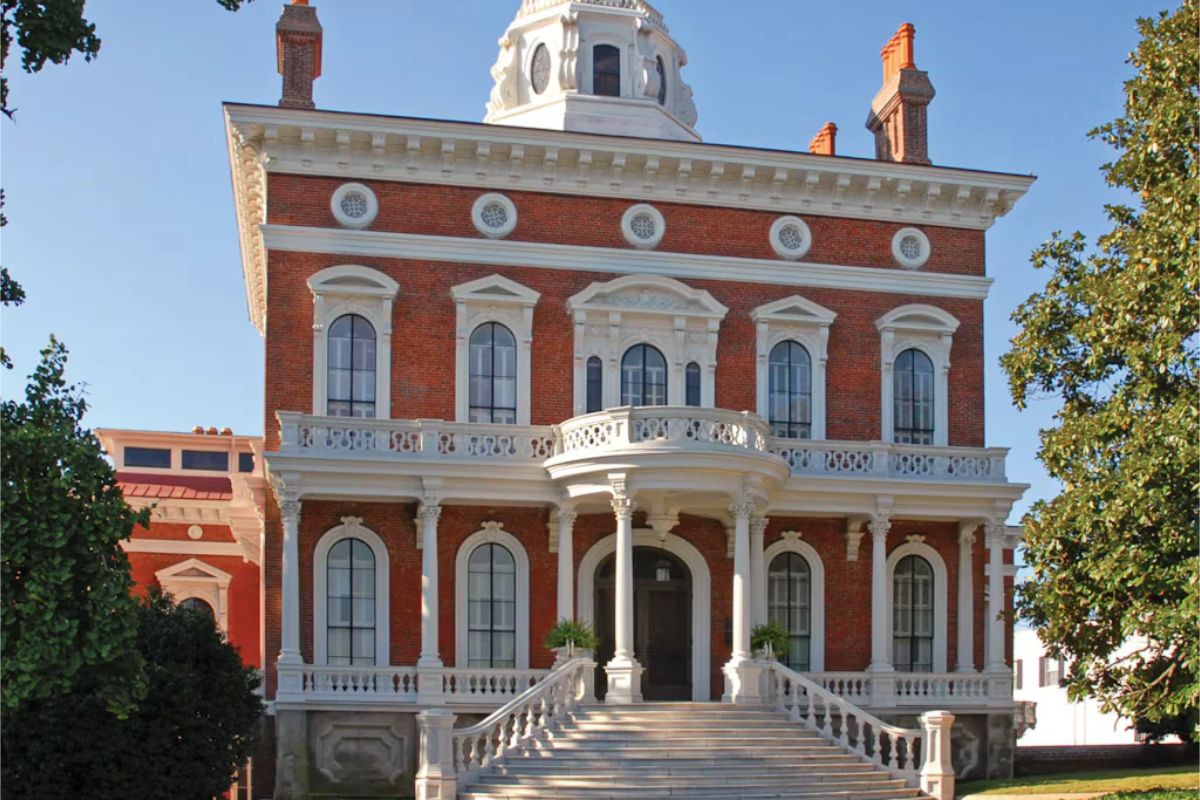
The Johnstons encountered the architecture and art of Italy and France firsthand. Rather than return home and build a conventional Southern plantation-style residence, they commissioned an extraordinary Italian Renaissance Revival mansion.
New York architect Thomas Thomas designed the house. Its remarkable interiors incorporated imported art, decorative painting, elaborate finishes, and sophisticated craftsmanship.
Hay House was technologically advanced for its era, featuring indoor plumbing, central heating, and elaborate ventilation systems when such conveniences were uncommon in American residences.
The mansion’s history did not end with the Johnstons. It passed through the Felton and Hay families, each adding another generation to its legacy.
Designated a National Historic Landmark in 1974, Hay House is preserved by the Georgia Trust for Historic Preservation. It remains one of Macon’s most compelling links to nineteenth-century architecture, European influence, and technological innovation.
For today’s architectural enthusiasts, the house demonstrates the enduring appeal of exceptional craftsmanship and distinctive residential design.
02 / THE MERCHANT’S MANSION
Burke Mansion: The Victorian Legacy of Thomas C. Burke
By the late nineteenth century, Macon’s prosperous merchant class was creating a different architectural identity for the city.
Among its most memorable residences is Burke Mansion, constructed in 1887 for Thomas C. Burke, a prominent businessman whose commercial enterprises supplied building materials and related goods to a growing region.
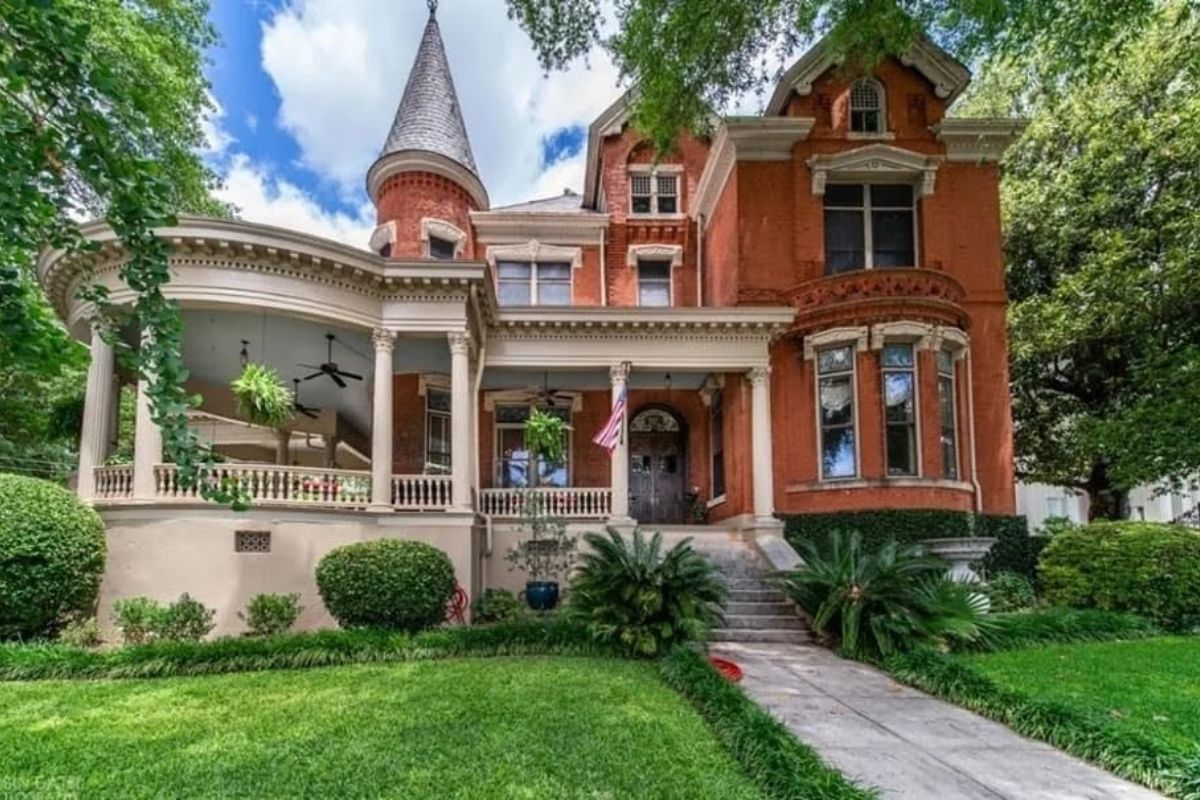
The building reflects the expressive character of Queen Anne Victorian architecture. Its richly detailed exterior, distinctive rooflines, ornamental elements, and historic interiors contrast sharply with the more symmetrical Greek Revival houses of an earlier generation.
Early twentieth-century additions incorporated architectural work by celebrated Georgia architect Neel Reid, connecting the estate to another chapter of regional architectural history.
The Burke family maintained a lasting connection to the property, and the residence eventually entered a new phase as a boutique bed-and-breakfast inn.
Its preservation illustrates how historic residential architecture can be adapted for contemporary hospitality without losing the character that originally made it significant.
03 / AN ANTEBELLUM LANDMARK
The 1842 Inn: John Gresham and Macon’s Early Elite
The property now celebrated as the 1842 Inn began as the residence of John Gresham, an influential Macon attorney, judge, civic leader, and cotton merchant.
Constructed in 1842, the Gresham House reflects the elegance of the Greek Revival movement, which became especially popular across the American South during the antebellum period.
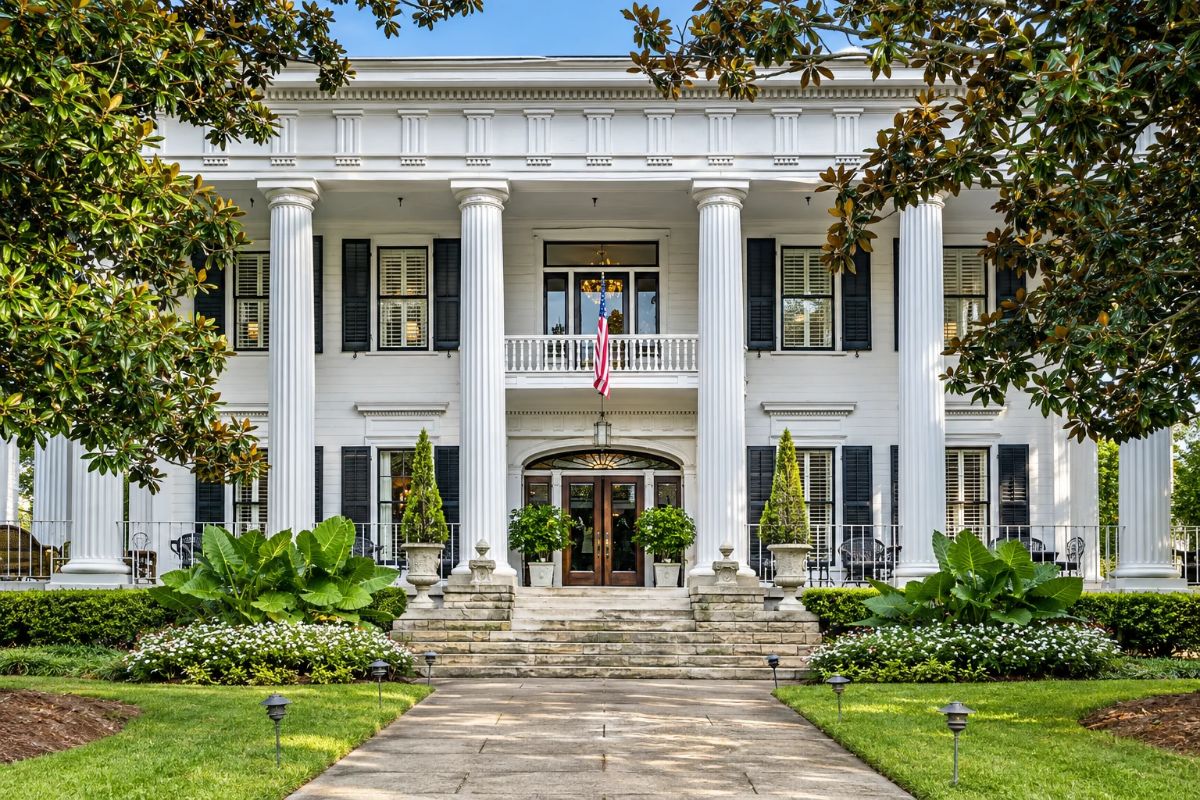
Classical proportions and prominent architectural details created an impression of refinement and status. The house embodied a desire among influential families to connect their residences visually with the architectural traditions of ancient Greece.
Over time, the property underwent changes in ownership and use. Today, the 1842 Inn incorporates both its original Greek Revival residence and an adjoining Victorian-era house, creating a distinctive setting for historic hospitality.
Its survival gives modern visitors an opportunity to experience the architectural character of Macon as the city emerged into an important nineteenth-century commercial center.
04 / INDUSTRY, FORTUNE & LITERATURE
The McCaw–Massee House: Macon’s Famous Crisco House
Among the city’s most fascinating historic residences is the McCaw–Massee House on College Street, widely known as the Crisco House.
Completed in 1901, the grand Beaux-Arts residence was designed by Macon architect Alexander Blair III for Wallace Eugene McCaw, a businessman associated with the Macon Manufacturing Company and the development of vegetable shortening technology.
McCaw’s work with hydrogenated cottonseed-oil products, including the shortening marketed as Plantene, contributed to the mansion’s enduring nickname and its connection to the history of Crisco.
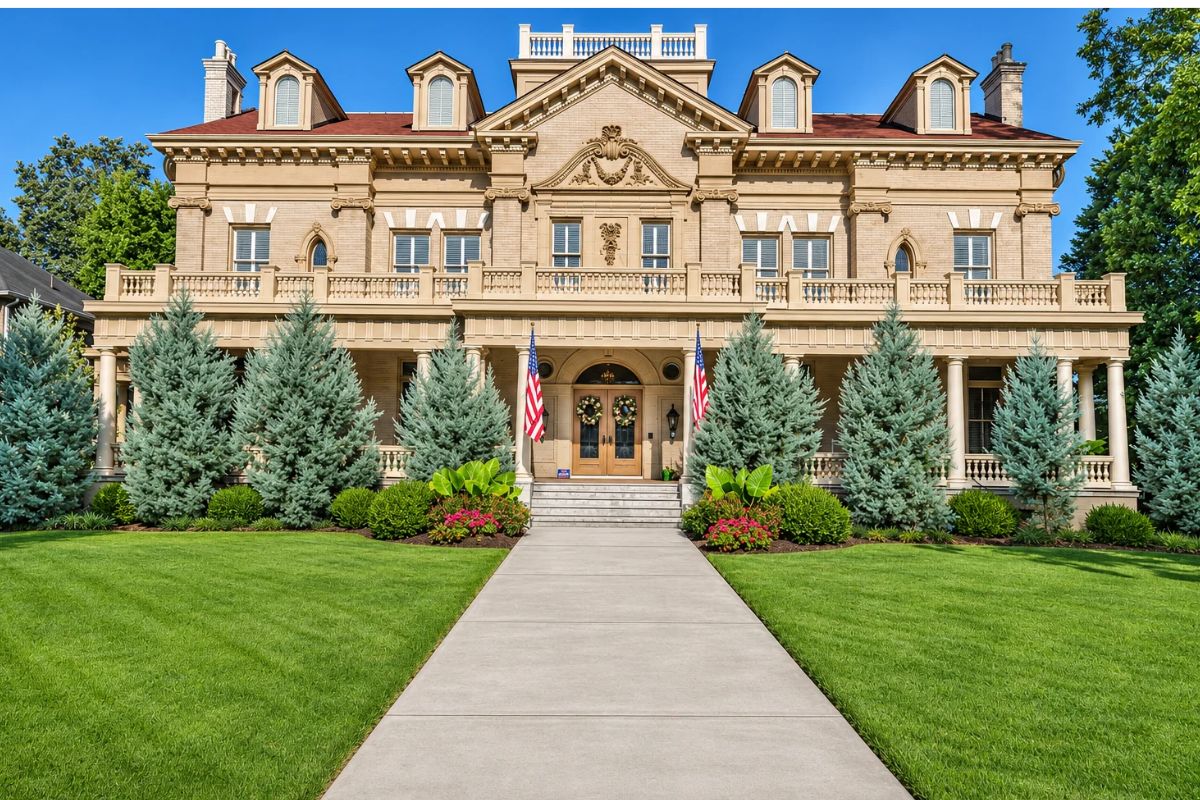
The residence represented the ambitions of an industrial family at the beginning of the twentieth century. Its commanding architecture, extensive interior spaces, and elegant design reflected both commercial success and the architectural fashions of the period.
Later, the Massee family became associated with the house, adding an important cultural dimension to its history.
Jordan Massee’s relationships with prominent literary figures, including Tennessee Williams and Carson McCullers, connected the residence to the artistic world of the twentieth-century American South.
Local accounts have long associated Massee with the character of Big Daddy in Tennessee Williams’s Cat on a Hot Tin Roof. That connection remains part of the property’s literary lore, although the extent of the inspiration is difficult to establish definitively.
Today, the house stands as a remarkable meeting point of architecture, industry, family history, and American literature.
Read more: Discover JoJo’s complete feature on The Historic Crisco House.
05 / RAILROADS & RESIDENTIAL GRANDEUR
Woodruff House: Jere Cowles and the Age of the Railroad
The Woodruff House, constructed in 1836, is one of Macon’s most important early Greek Revival residences.
Designed by architect-builder Elam Alexander for Jere Cowles, a railroad financier, the residence occupies a prominent position near Coleman Hill.
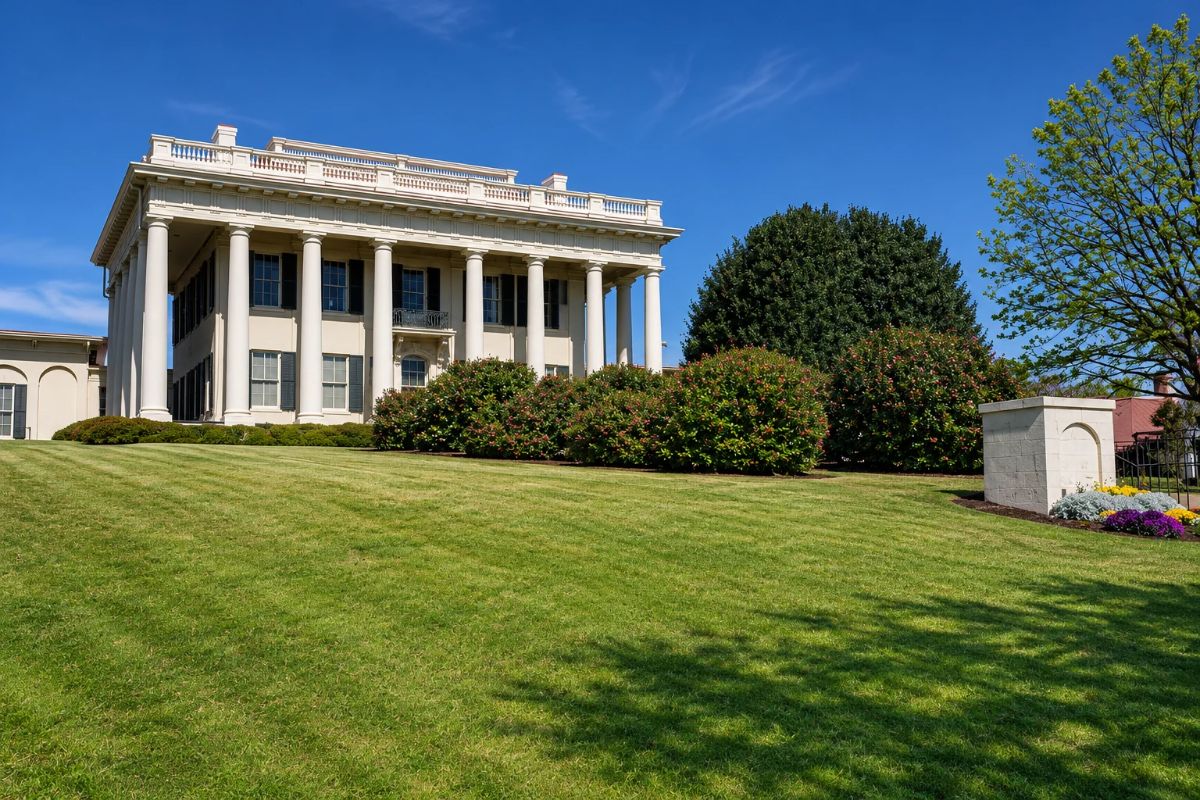
Its imposing classical design and monumental columns communicated the ambitions of a young city whose business leaders were investing in transportation and trade.
Later associated with Joseph Bond and subsequent owners, the house evolved through multiple periods of Macon’s history.
Today, Woodruff House is connected with Mercer University, preserving an important example of Macon’s nineteenth-century architectural heritage.
06 / A HOUSE THAT WITNESSED WAR
Cannonball House: Judge Asa Holt and the Civil War
Some historic houses become famous because of their architecture. Others become landmarks because of a single extraordinary event.
Macon’s Cannonball House is remarkable for both reasons.
Built in 1853 for Judge Asa Holt, the Greek Revival residence became part of Civil War history when Federal artillery struck the house during military operations around Macon in July 1864.
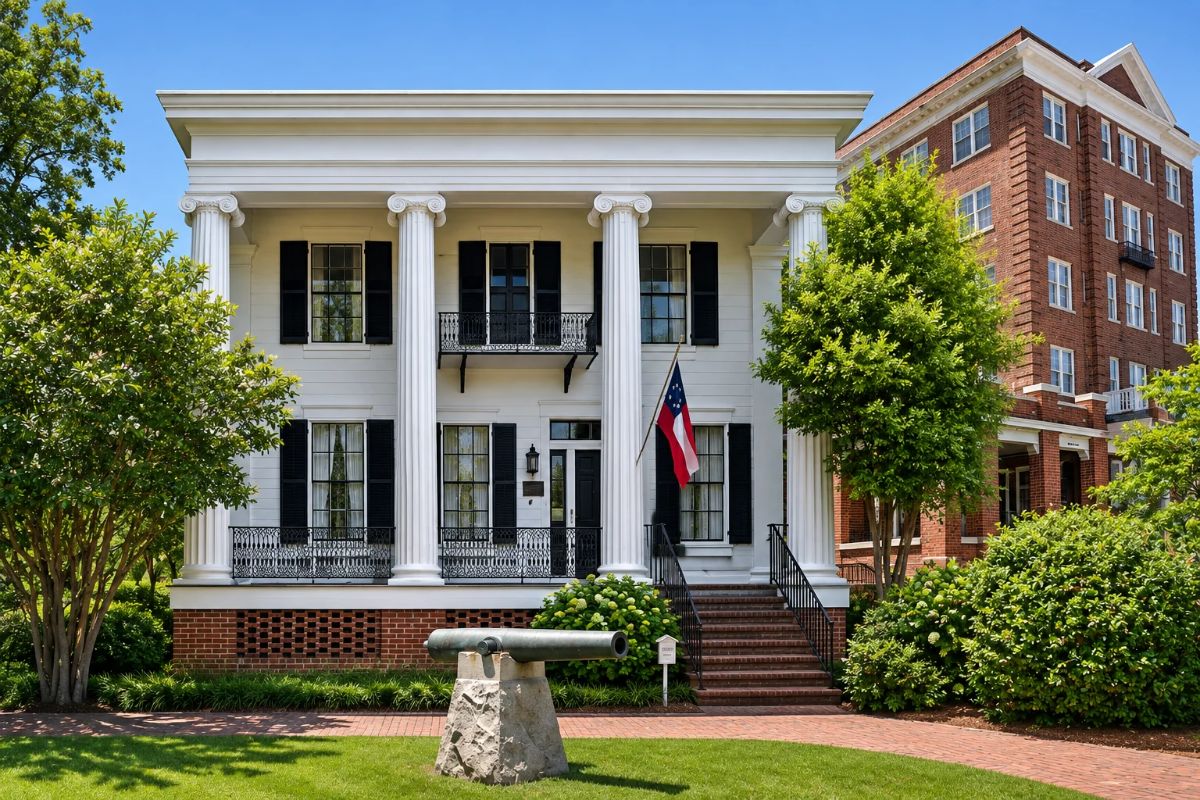
According to the Georgia Historical Society’s marker, the projectile struck near the front of the house, passed through architectural elements, and entered the residence without exploding.
That episode gave the home the name by which generations of residents would remember it.
The building’s importance extends beyond the cannonball itself. It provides insight into domestic life during a period of enormous national conflict and stands as a reminder that the Civil War affected residential communities as well as battlefields.
Preserved as a museum, the Cannonball House remains one of Macon’s most recognizable historical attractions.
07 / AN ARCHITECTURAL MASTERPIECE
Carmichael House: Elam Alexander’s Ingenious Design
The Raines–Miller–Carmichael House is among the most architecturally inventive surviving nineteenth-century residences in Macon.
Constructed around 1848 for Judge Cadwalader Raines by master builder Elam Alexander, the house departed from conventional rectangular domestic layouts.
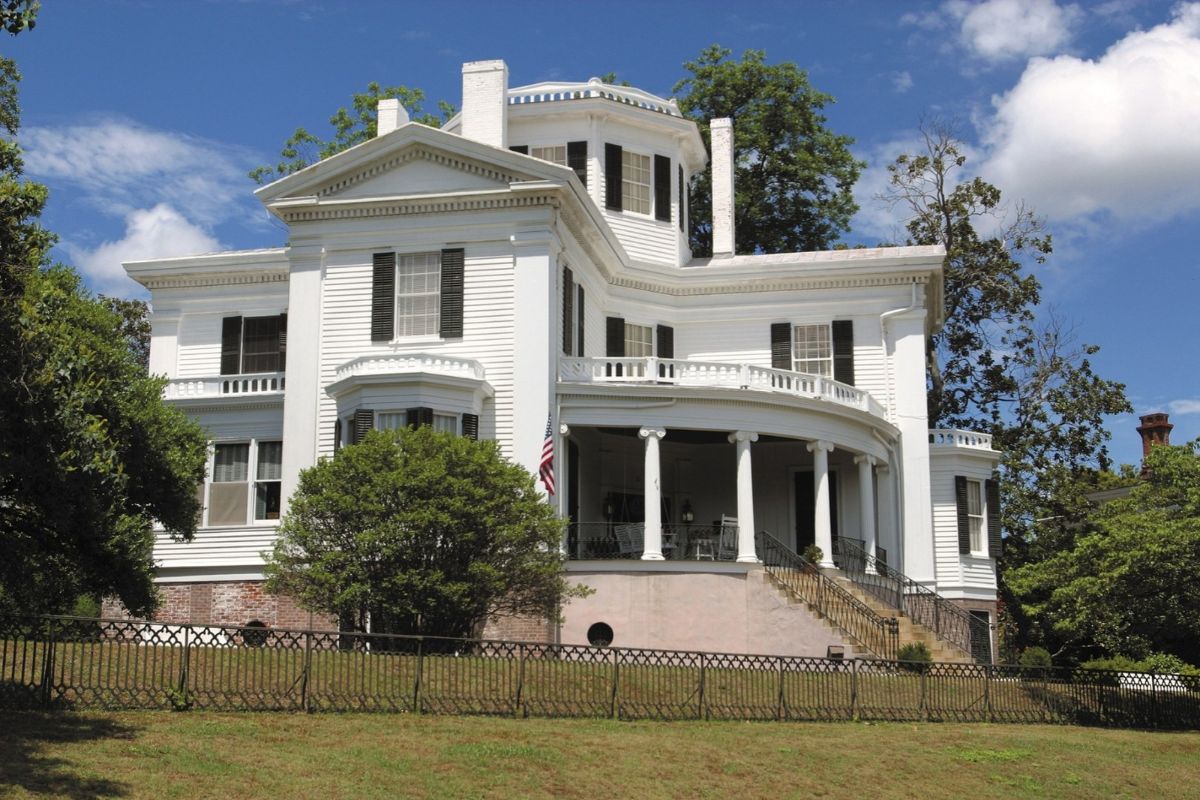
Instead, its plan resembles a Greek cross, with rooms extending outward from an extraordinary central space beneath an octagonal tower.
The arrangement introduced unusual opportunities for circulation, light, ventilation, and interior drama. Its distinctive staircase and classical porches demonstrate the technical imagination of a builder who played an important role in shaping early Macon’s architectural identity.
Elam Alexander was more than a designer of residences. His career included public buildings, educational institutions, and other structures that contributed to the development of Macon.
The Carmichael House, recognized as a National Historic Landmark, preserves one of the clearest demonstrations of his architectural ability.
THE ARCHITECTS BEHIND MACON
Elam Alexander, Alexander Blair III & Neel Reid
Macon’s architectural identity was shaped by several generations of talented designers and builders.
Elam Alexander helped establish the city’s Greek Revival architectural character during the nineteenth century, contributing to residences including Woodruff House and the Carmichael House.
Alexander Blair III was responsible for the imposing McCaw–Massee House, demonstrating the growing popularity of Beaux-Arts design around the turn of the twentieth century.
Neel Reid became one of Georgia’s most celebrated early twentieth-century residential architects. His work and influence appear in numerous Macon residences, including houses in the College Street and Vineville areas, and demonstrate the growing popularity of historically inspired domestic architecture.
PART THREE • HOMES WITH EXTRAORDINARY STORIES
Where Architecture Meets Literature, Music & Culture
Not every significant historic residence owes its importance to an enormous fortune or elaborate architectural design. Some are remembered because of the remarkable people who lived within their walls.
08 / A POET’S BEGINNING
Sidney Lanier Cottage: The Birthplace of a Southern Literary Figure
In 1842, poet and musician Sidney Lanier was born in a Macon cottage that would eventually become one of the city’s treasured historic literary sites.
Unlike the monumental mansions of Georgia Avenue, the Sidney Lanier Cottage offers a more intimate perspective on nineteenth-century life.
Lanier later became known for poetry that explored nature, landscape, and the culture of the American South. His literary achievements helped establish a lasting connection between Macon and American letters.
The cottage has been preserved as an important reminder that a relatively modest residence can possess extraordinary cultural significance.
09 / AN ITALIAN DREAM IN GEORGIA
Villa Albicini: The Horgan Family’s Italian-Inspired Estate
One of Macon’s most unexpected architectural treasures stands on Tucker Road, far removed in appearance from the traditional Southern mansion.
Known as Villa Albicini, the residence was commissioned by the Horgan family in the 1920s. Its design is associated with acclaimed architect Philip Trammell Shutze, one of the most important classical architects working in Georgia during the twentieth century.
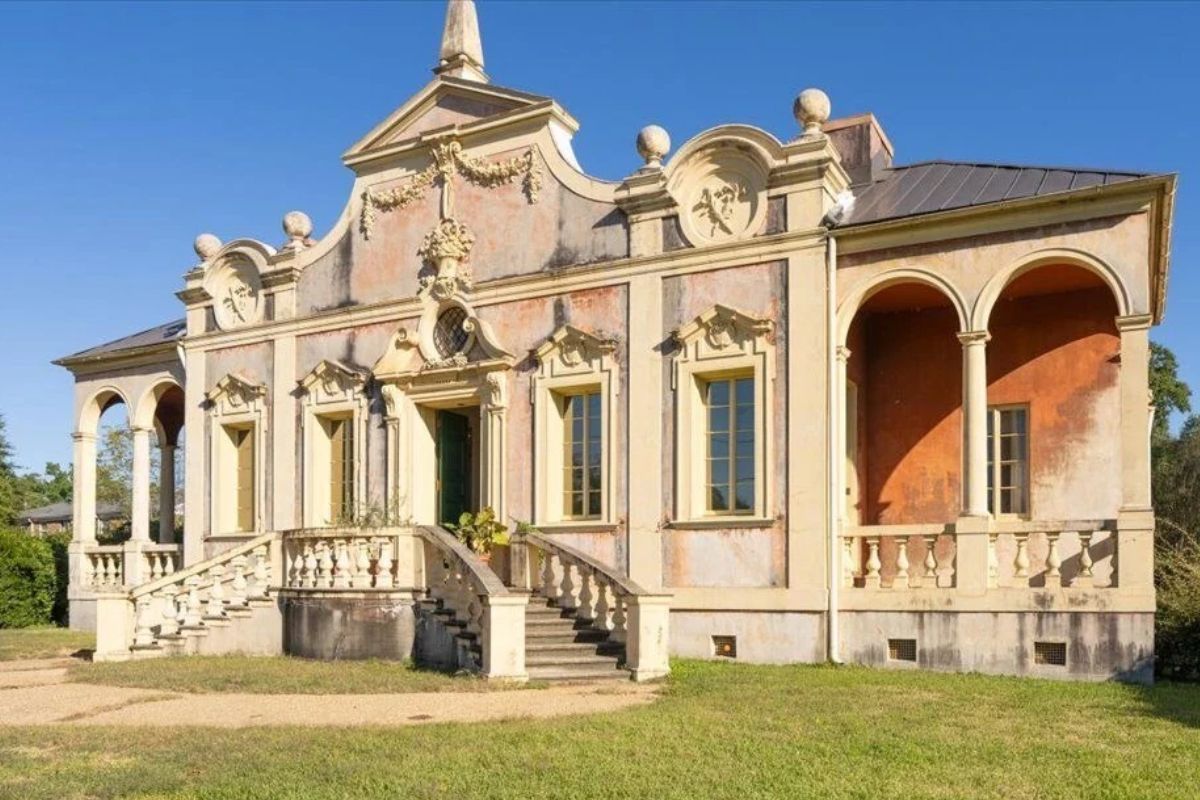
Inspired by Italian architecture, particularly a chapel at Villa Cuzzano in Italy, the estate incorporates the dramatic qualities of Italian Baroque design.
Its unusual proportions, intricate detailing, and carefully conceived spaces created a residence unlike almost anything else in Middle Georgia.
Villa Albicini illustrates how international architectural influences continued shaping Macon’s residential landscape long after the nineteenth-century building boom.
10 / A LANDMARK IN SOUTHERN ROCK
The Bell House: From Nineteenth-Century Residence to Album-Cover History
The residence now commonly known as the Bell House began its life in the nineteenth century, associated with Nathan Beall and later families.
Over the generations, architectural modifications transformed the house and its appearance. But its greatest modern cultural distinction arrived in 1969.
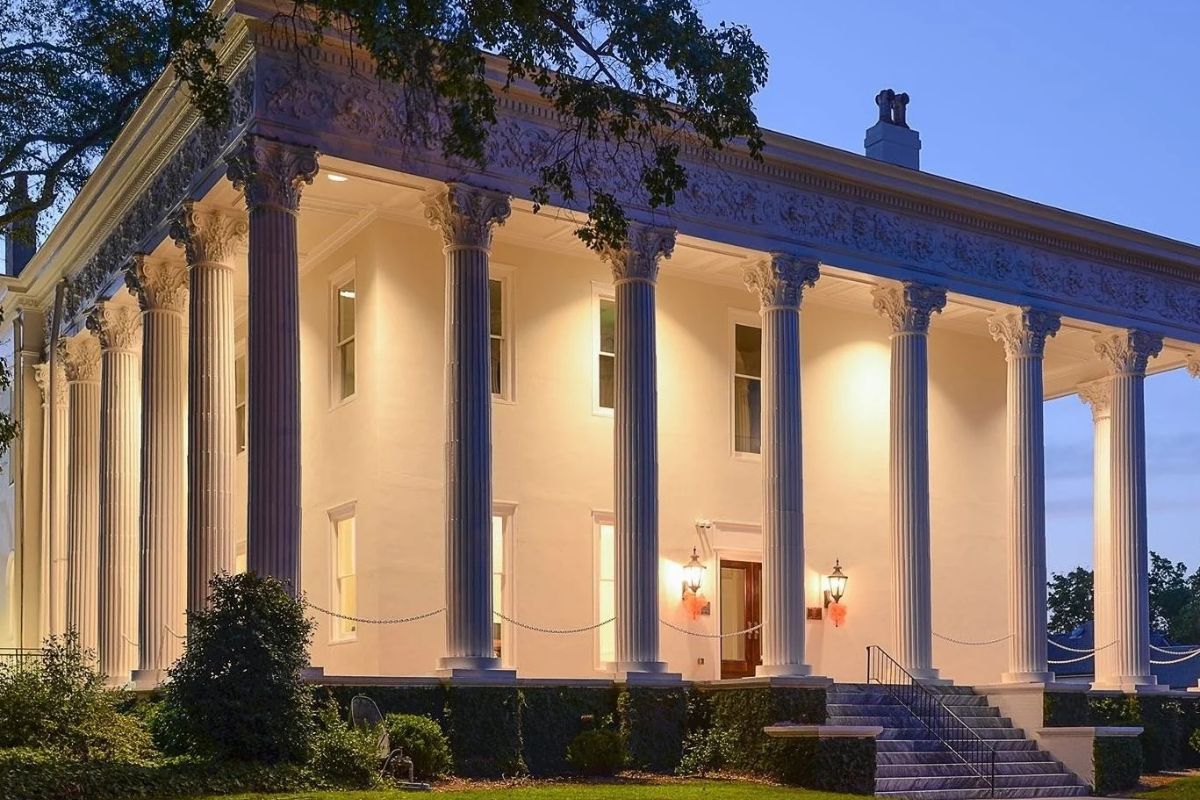
The Allman Brothers Band posed on its front porch for the cover photograph of their self-titled debut album, connecting the historic College Street residence to an extraordinary period in American music history.
Decades later, preservation efforts gave the building another purpose. It became associated with Mercer’s Robert McDuffie Center for Strings, preserving a fitting relationship between the house and Macon’s musical heritage.
The Bell House demonstrates how a residence can acquire historical importance through events that its original owners could never have imagined.
11 / THE HOME THAT HELPED SHAPE SOUTHERN ROCK
The Big House: Where the Allman Brothers Band Made History
At 2321 Vineville Avenue stands one of America’s most recognizable houses associated with rock music.
The Tudor Revival residence became known as the Big House when members of the Allman Brothers Band, their families, friends, and road crew made it a communal home in the early 1970s.
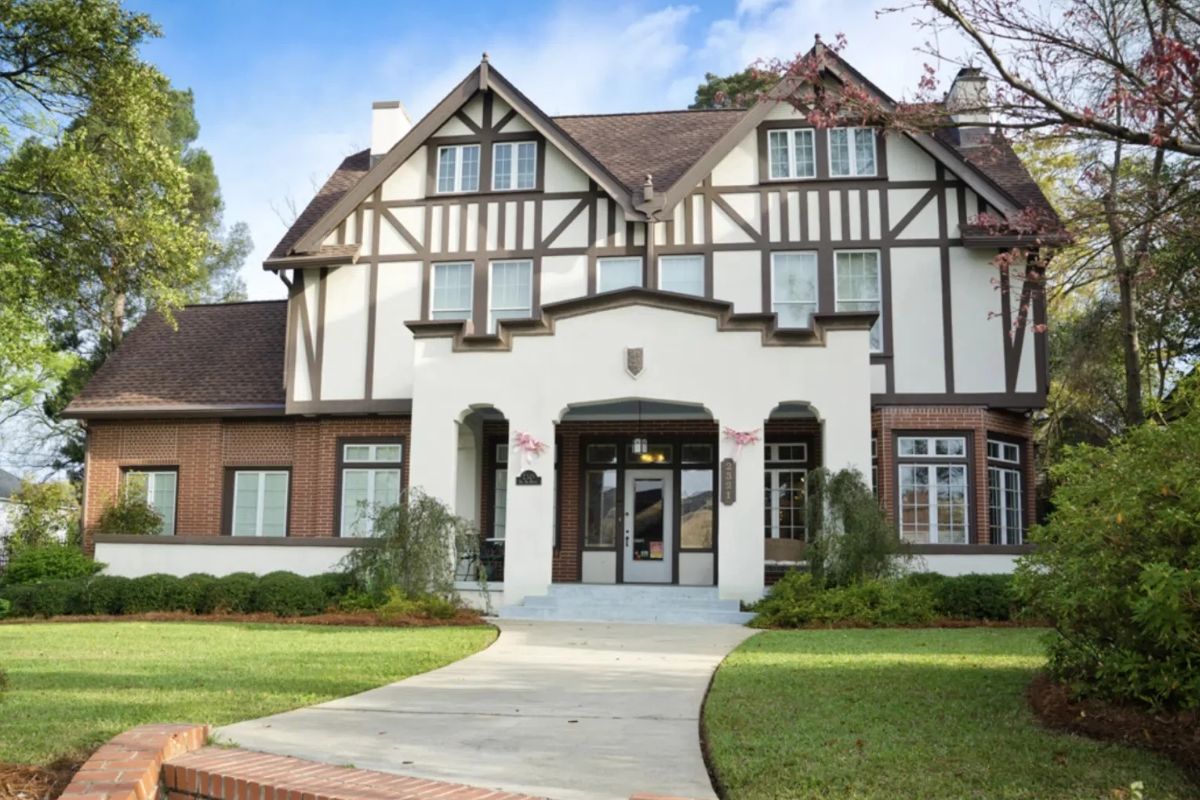
From 1970 through 1973, the house witnessed a formative period of collaboration, creativity, and personal tragedy as the band developed its distinctive musical identity.
Its importance lies as much in the relationships and music created there as in the physical building itself.
Now preserved as the Allman Brothers Band Museum, the Big House connects Macon’s residential architecture to its nationally recognized musical history.
Explore further: Read The Big House: History, Music and Mystery in Macon
12 / A CONNECTION TO AN AMERICAN FORTUNE
The Holt Family Home and the Doris Duke Connection
The histories of some Macon residences extend into the biographies of nationally prominent families.
One example is the historic Holt family residence associated with Nanaline Holt, who later married tobacco industrialist James Buchanan Duke.
Their daughter, Doris Duke, became one of the most famous American heiresses of the twentieth century and developed a legacy of philanthropy, art collecting, and historic preservation.
The family connection illustrates how Macon’s nineteenth-century social history intersected with the expanding industrial fortunes of the United States.
MORE ARCHITECTURAL TREASURES
Other Significant Residences of Historic Macon
Joseph N. Neel House: An important Tudor Revival residence associated with architect Neel Reid, reflecting Macon’s early twentieth-century enthusiasm for historic European domestic styles.
Walker–Shinholser–Rushin House: A College Street residence whose changing design and uses illustrate how historic houses evolved across generations. Neel Reid contributed to its later architectural identity.
Max Morris House: A Vineville residence associated with Neel Reid’s work and the Colonial Revival movement, demonstrating the architectural character of Macon’s expanding residential neighborhoods.
Solomon–Smith House: An example of the Plantation Plain house type within the Vineville Historic District, representing an earlier regional architectural tradition.
Melrose–Barton House: An early Greek Revival residence associated with the architectural history of North Highlands and the development of residential districts beyond the original downtown core.
PART FOUR • MACON’S CULTURAL HERITAGE
Beyond the Mansions: Homes That Preserve Community History
To understand the history of Macon’s homes, we must look beyond its grandest estates.
Neighborhood cottages, modest family residences, and longstanding communities also represent essential chapters of the city’s architectural and cultural development.
Pleasant Hill, for example, developed as an important neighborhood with a distinguished legacy of education, enterprise, community leadership, and music.
Among its most celebrated residents was Richard Wayne Penniman, internationally known as Little Richard, whose childhood home became an important preservation project.
Originally located on Fifth Street, the house was saved, relocated to Craft Street, and rehabilitated. Its preservation demonstrates that historic significance is not measured by square footage, architectural ornament, or an owner’s wealth.
Architect Louis H. Persley, who grew up in Macon’s Pleasant Hill neighborhood, also deserves recognition in the broader history of architecture in the region.
Together, these stories demonstrate the importance of preserving residential history across different communities, architectural traditions, and generations of local achievement.
PART FIVE • MILLEDGEVILLE’S HISTORIC HOMES
The Residential Legacy of Georgia’s Former Capital
A short journey northeast of Macon leads to Milledgeville, a city whose architectural history was shaped by its role as Georgia’s capital from 1804 until 1868.
Government officials, attorneys, merchants, and influential families helped create an exceptional collection of early nineteenth-century buildings.
Milledgeville’s historic residences reflect Federal, Greek Revival, and later architectural styles, while their stories reveal the political, social, and cultural importance of Georgia’s former capital.
13 / THE GOVERNORS’ RESIDENCE
Georgia’s Old Governor’s Mansion: A House at the Center of State History
Completed in 1839, Georgia’s Old Governor’s Mansion is among the state’s most distinguished examples of High Greek Revival architecture.
The monumental residence served as the home of Georgia’s governors during a period of dramatic political and social change, including the years before the Civil War, the conflict itself, and the early Reconstruction period.
Its imposing classical architecture projected the authority of state government and reflected the architectural ideals of its era.
Unlike the private mansions built for wealthy families, this residence was intended to symbolize public office and the prestige of Georgia’s state capital.
Today, preserved as a historic museum associated with Georgia College, it offers an important window into nineteenth-century political and domestic life.
14 / A MANSION REBORN
Rose Hill: Judge Daniel R. Tucker and a House Rebuilt After Fire
Rose Hill, the historic centerpiece of Lockerly Arboretum, is one of Baldwin County’s finest surviving Greek Revival residences.
The present house was built in 1852 for Judge Daniel R. Tucker after an earlier residence on the property was destroyed by fire.
Its classical design, balanced proportions, and traditional floor plan reflect the architectural aspirations of prosperous nineteenth-century families.
Rose Hill’s story is particularly compelling because it combines destruction, rebuilding, landscape history, and successful preservation.
The residence now stands within the landscaped setting of Lockerly Arboretum, where architecture and horticultural heritage remain closely connected.
15 / THE FEDERAL PERIOD
Brown–Stetson–Sanford House: An Early Milledgeville Landmark
Built in 1825 by John Marlor, the Brown–Stetson–Sanford House represents an architectural period that preceded the full popularity of Greek Revival design in Georgia.
Its Federal-style character reflects the formal proportions and relatively restrained decoration favored in the early nineteenth century.
The house acquired a variety of uses over time, including residential and hospitality functions, before becoming part of the region’s preservation story.
Its history demonstrates how buildings can survive through relocation, adaptation, and the continued determination of communities to protect their architectural heritage.
16 / THE HOME OF A LITERARY GIANT
Andalusia Farm: The World of Flannery O’Connor
Not all of Middle Georgia’s historically important homes are grand urban mansions.
Andalusia Farm, near Milledgeville, became the home of celebrated Southern Gothic writer Flannery O’Connor during the final years of her life.
O’Connor lived at Andalusia from 1951 until her death in 1964, producing some of the most influential fiction of twentieth-century American literature.
The rural setting, farm buildings, surrounding countryside, and rhythms of life in Middle Georgia became closely associated with her work.
Preserved as a literary landmark, Andalusia demonstrates the profound connection between a home, its landscape, and the creative achievements of the person who lived there.
17 / EDUCATION & COMMUNITY LEADERSHIP
Sallie Ellis Davis House: A Home Dedicated to Opportunity
In Milledgeville’s historic Eddy neighborhood stands the residence of Sallie Ellis Davis, an influential educator whose life was devoted to education and community advancement.
Davis understood the power of education to transform lives. Her home became associated not only with her personal life but also with the students and families she served.
At one point, part of the residence accommodated student boarders, reflecting her commitment to making education more accessible.
Today, the preserved home tells a story of perseverance, educational leadership, and the importance of historic places that represent achievements beyond architectural grandeur.
PART SIX • HISTORIC PERRY & HOUSTON COUNTY
The Historic Residences of Perry, Georgia
South of Macon, Perry preserves an impressive collection of historic residences reflecting its development as a county seat and regional community.
Many of these houses are less internationally famous than Macon’s grand mansions, but they represent an equally important part of Middle Georgia’s architectural character.
The city’s historic resource surveys document residences associated with prominent local families, builders, and multiple generations of architectural change.
Today, Perry offers buyers an opportunity to explore established neighborhoods and a varied residential landscape while remaining connected to the broader Middle Georgia region.
18 / ANTEBELLUM PERRY
Swift–Tolleson House
Dating to approximately 1857, the Swift–Tolleson House on Swift Street is among the historically significant residences documented in Perry’s architectural surveys.
Its history is associated with Judge William Tyre Swift and later families, reflecting the social and economic development of Houston County during the nineteenth century.
The residence helps illustrate how Greek Revival architectural influences appeared not only in large regional cities but also in prosperous smaller communities.
19 / CHANGING ARCHITECTURAL TASTES
Powers–Mann–Beckham House
The Powers–Mann–Beckham House, dating to the mid-nineteenth century, demonstrates how older residences could be moved, remodeled, and reinterpreted as architectural tastes changed.
Its combination of antebellum origins and later classical design influences makes it an important example of a building whose history unfolded across multiple eras.
Such residences remind us that historic architecture is rarely frozen in the precise form in which it was originally constructed.
20 / A NEW CENTURY OF DESIGN
Cooper–Evans House
Dating to approximately 1902, the Cooper–Evans House represents the changing domestic architecture of Perry around the turn of the twentieth century.
Its Neoclassical Revival character reflects the growing preference for formal classical design during a period when American architecture was increasingly revisiting the monumental traditions of earlier centuries.
Together with the Swift–Tolleson and Powers–Mann–Beckham residences, it helps illustrate the evolution of Houston County’s residential architecture.
More Historic Homes of Perry
Cooper–Hurlbutt House: A notable local example of Victorian-era Stick-style influence, reflecting a more decorative architectural approach than the classical residences of an earlier period.
Singleton–Killen–Anderson House: Recognized in local preservation documentation as an important example of early residential building traditions in Houston County.
Killen–Staples House: A distinguished nineteenth-century residence illustrating Carpenter Italianate influences and the architectural variety of the region.
PART SEVEN • FORSYTH & MONROE COUNTY
The Historic Residential Heritage of Forsyth
North of Macon, Forsyth and Monroe County preserve historic residences that reflect the development of smaller Georgia communities during the nineteenth and early twentieth centuries.
Forsyth’s historic architecture includes Greek Revival houses, traditional Southern residences, Victorian details, and later adaptations of classical domestic design.
Among the notable properties is the house associated with Judge Alexander Speer, an early Greek Revival-era residence connected with Forsyth’s civic history.
The Sharp–Hardin–Wright House, also known as Hil’ardin, represents another important architectural landmark in the community and is recognized through historic preservation documentation.
Elsewhere in Monroe County, properties such as Great Hill Place contribute to the broader story of rural estates and distinguished historic residences outside Macon’s central urban neighborhoods.
Together, these homes show that Middle Georgia’s historic architectural identity extends beyond its most famous cities and into county seats, small towns, and the surrounding countryside.
For today’s homebuyers, Forsyth and Monroe County present another dimension of Middle Georgia living, including established residential communities, historic architecture, and properties with a range of lot sizes and settings.
PART EIGHT • THE NEIGHBORHOODS THEMSELVES
Macon’s Historic Neighborhoods: Living Architectural Collections
Individual historic houses can be extraordinary, but entire neighborhoods tell an even larger story.
Macon’s historic residential districts reveal how the city’s architecture changed over generations, from early estates and classical mansions to Victorian houses, Craftsman bungalows, and twentieth-century suburban residences.
These neighborhoods remain an important part of Macon’s appeal to buyers seeking established communities, architectural individuality, and homes that reflect the character of their surroundings.
Where to Discover Historic Residential Architecture
InTown Macon: An especially rich concentration of nineteenth-century mansions, historic institutions, Victorian homes, and architecture associated with the city’s early commercial prosperity.
Vineville: A significant historic district where early Plantation Plain residences, stately revival-style houses, Tudor architecture, and twentieth-century homes reflect Macon’s continued expansion.
Shirley Hills: Known for its attractive residential setting, distinctive houses, and architectural character associated with early twentieth-century suburban development.
Huguenin Heights: A historic residential neighborhood notable for its late nineteenth- and early twentieth-century architectural character and preservation activity.
Tatnall Square Heights: A neighborhood where historic residential architecture, educational institutions, and the surrounding College Hill environment form a distinctive urban landscape.
Ingleside: An important part of Macon’s twentieth-century residential development, with an appealing mix of traditional houses, bungalows, and neighborhood commercial history.
Pleasant Hill: A historically important neighborhood whose legacy includes education, community leadership, cultural achievement, music, and ongoing preservation efforts.
Macon’s historic neighborhoods are part of a much larger story of growth, architectural innovation, and real estate development. From the city’s earliest residential districts to the established communities that attract today’s homebuyers, Macon’s housing history reveals how the region evolved into the market we know today. Discover the fascinating story in our comprehensive guide, History of Macon GA Real Estate.
PART NINE • PRESERVING THE PAST
Why Historic Preservation Matters in Middle Georgia
Every historic building that survives represents a decision, whether made by an individual homeowner, a community organization, a preservation advocate, or a public institution.
Preserving a historic residence often demands a commitment beyond ordinary property maintenance. Older buildings may require specialized craftsmanship, period-appropriate materials, structural repairs, or sensitive upgrades to modern systems.
Yet successful preservation does more than protect a single building. It can strengthen neighborhood identity, preserve cultural memory, support local craftsmanship, and encourage reinvestment in established communities.
Historic Macon Foundation has played an important role in protecting and revitalizing the city’s architectural heritage through education, advocacy, rehabilitation, and neighborhood initiatives.
The Georgia Trust for Historic Preservation likewise contributes to the protection of significant historic properties throughout the state, including Hay House.
Their work demonstrates that preservation is not simply about keeping old buildings standing. It is about ensuring that future generations can experience the architecture, craftsmanship, and stories that give communities their distinctive identities.
Preservation can also complement modern neighborhood reinvestment. Thoughtfully rehabilitated homes may contribute to the appeal and stability of surrounding streets while creating opportunities for new residents to participate in the continuing history of Macon.
Historic Preservation Resources
Historic Macon Foundation: HistoricMacon.org
Georgia Trust for Historic Preservation: GeorgiaTrust.org
Georgia Historic Preservation Division: Georgia Historic Preservation Resources
National Park Service: Historic Preservation Information
PART TEN • MACON REAL ESTATE TODAY
Why Macon’s Architectural Heritage Matters to Today’s Homebuyers and Investors
Historic architecture is often discussed as something from the past. In Macon, however, it is also an important part of the city’s residential identity and an appealing feature of its present-day real estate market.
For buyers evaluating Middle Georgia, Macon’s relative affordability is another reason to explore the market. Housing data from 2026 shows a range of opportunities across the city, although prices, inventory, and conditions vary considerably by neighborhood and property type.
Importantly, thoughtful buyers can use today’s market conditions to compare options, inspect properties carefully, and evaluate a home’s long-term suitability rather than make a rushed decision.
Historic neighborhoods may also offer opportunities for buyers interested in rehabilitation and long-term ownership.
Restoring original details, addressing deferred maintenance, and making appropriate modern improvements can contribute to a property’s usefulness and preserve the character of the surrounding community.
The combination of distinctive architecture, established residential neighborhoods, and local preservation activity makes Macon particularly interesting for buyers who appreciate properties with individuality and history.
There is another timely consideration: Georgia’s historic rehabilitation tax-credit program includes incentives for certain qualifying historic properties, with changes to owner-occupied residential eligibility taking effect in 2026.
Depending on a property’s designation, proposed improvements, and required approvals, eligible owners may have access to state tax incentives that help support appropriate rehabilitation.
Buyers should confirm current eligibility requirements with the Georgia Department of Community Affairs and a qualified tax professional before purchasing or beginning work.
For property investors, the opportunity is best understood as property-specific rather than guaranteed. A carefully selected house in an established area may suit renovation, resale, long-term ownership, or a permitted rental strategy.
Success depends on realistic acquisition costs, financing, property condition, renovation budgets, local demand, operating expenses, and preservation requirements.
Potential appreciation, rental income, or equity growth should be evaluated independently rather than assumed.
What makes Macon distinctive is the opportunity to explore a varied residential market within a city actively working to preserve its architectural identity and revitalize important neighborhoods.
For some buyers, the ideal property will be a restored historic mansion. For others, it may be a Craftsman bungalow, a traditional home on a tree-lined street, or an older residence offering an opportunity for thoughtful improvements.
In each case, the appeal extends beyond the physical house. Buyers are also considering neighborhood character, accessibility, local amenities, historical surroundings, and the opportunity to become part of an established Middle Georgia community.
What Makes Macon Worth Exploring for Real Estate?
Architectural distinction: A remarkable variety of historic residential designs, ranging from Greek Revival and Victorian to Craftsman, Tudor, and Colonial Revival.
Established neighborhoods: Communities with recognizable identities, mature landscapes, and generations of residential history.
Varied housing opportunities: A market that includes restored historic houses, more modest older residences, and properties with potential for carefully planned improvements.
Preservation and reinvestment: Public and nonprofit efforts that help maintain important buildings and encourage neighborhood revitalization.
Accessible price points: Opportunities to compare homes across a range of budgets, property types, and locations within Macon and the wider Middle Georgia region.
Long-term perspective: The possibility of selecting a property that meets present-day needs while preserving architectural character and evaluating its future ownership potential.
PART ELEVEN • HISTORIC HOMEOWNERSHIP TODAY
What Buyers Should Know About Owning a Historic Home in Macon or Middle Georgia
For many buyers, the appeal of a historic home is immediate.
Original hardwood floors, decorative fireplaces, generous front porches, detailed millwork, substantial doors, soaring ceilings, and distinctive architectural features can create a sense of character difficult to reproduce in contemporary construction.
Historic homes also offer something less tangible: a connection to the history and personality of a neighborhood.
However, the decision to purchase an older residence deserves careful consideration. A successful historic-home purchase combines an appreciation for architectural character with a practical understanding of the property’s condition and ownership requirements.
Seven Important Considerations for Historic Homebuyers
1. Building Systems and Inspections. Older residences may contain aging electrical systems, plumbing, HVAC equipment, roofing, or structural components. A qualified home inspector familiar with older construction can help identify concerns, and specialized inspections may be necessary.
2. Historic District Designation. A property listed in the National Register of Historic Places is not necessarily subject to the same requirements as a locally designated historic property. Buyers should determine which designations and local regulations apply.
3. Renovation and Restoration. Some projects may require specialized materials or tradespeople experienced in historic construction. Exterior alterations may also require review by a local preservation commission.
4. Insurance and Replacement Costs. Historic architectural details and unusual construction materials can affect repair costs and insurance considerations. Buyers should discuss appropriate coverage with a qualified insurance professional.
5. Energy Efficiency. Older windows, insulation systems, and mechanical equipment may perform differently from modern construction. Improvements should balance energy efficiency with preservation of important architectural features.
6. Preservation Incentives. Certain qualifying rehabilitation projects may be eligible for state or federal preservation incentives. Eligibility, requirements, and available benefits depend on the property, the work, and current program rules.
7. The Long-Term Commitment. Historic homeownership can be rewarding, but thoughtful maintenance and planning are essential to protecting the property’s condition and distinctive features.
For a deeper understanding of renovation considerations, preservation requirements, and the standards that may apply to older properties, explore JoJo’s Standards for Historic Properties resource.
A knowledgeable real estate professional can help buyers identify suitable historic neighborhoods, review property information, understand available opportunities, and connect with qualified inspectors and other specialists when necessary.
PART TWELVE • A LIVING LEGACY
Why Historic Homes Continue to Define Macon & Middle Georgia
The historic homes of Macon and Middle Georgia represent far more than examples of architecture from another century.
They document the enterprise of early merchants, the growth of agriculture and commerce, the ingenuity of talented architects, the importance of education, the creativity of writers and musicians, and the dedication of communities to preserving their heritage.
The Hay House tells a story of international influence and extraordinary craftsmanship. Burke Mansion reflects the growing prosperity of a merchant class. The McCaw–Massee House connects industrial innovation with literary history. The Cannonball House remembers a moment of military conflict, while the Big House preserves a defining chapter in American music.
Beyond Macon, Milledgeville’s distinguished residences reveal the political and cultural history of Georgia’s former capital. Perry and Forsyth preserve the architectural character of smaller communities that helped shape the wider region.
Taken together, these buildings tell a story of continuity and change.
Their survival is especially meaningful today because the communities around them remain places where people live, work, raise families, restore properties, and establish their own traditions.
For those considering Macon real estate, architectural heritage adds an important dimension to the practical questions of location, price, condition, and long-term value.
For buyers drawn to distinctive architecture and a strong sense of place, the historic homes and established neighborhoods of Macon and Middle Georgia offer a compelling opportunity: to find a home suited to life today while becoming a thoughtful steward of a story that began generations ago.
THE BEAUTY OF HISTORIC HOMEOWNERSHIP
“The most remarkable homes do not merely reflect the lives of those who came before us. They provide a beautiful setting for the memories and traditions of generations still to come.”
YOUR MACON & MIDDLE GEORGIA REAL ESTATE CONNECTION
Discover Historic Homes with Joanna “JoJo” Jones
Whether your goal is to own a restored Victorian mansion, find a classic Craftsman bungalow, purchase a charming historic cottage, or evaluate an older property with renovation potential, Joanna “JoJo” Jones can help you explore Macon and Middle Georgia with attention to neighborhood character, property condition, and market value.
As a real estate professional with Sheridan Solomon & Associates, JoJo brings local market knowledge and a personal approach to buyers and sellers throughout Macon and Middle Georgia.
Explore JoJo’s dedicated historic-homes resource or visit her Listings Hub to discover properties and continue your home search.
Joanna “JoJo” Jones • Sheridan Solomon & Associates
HISTORICAL RESEARCH & FURTHER READING
Historical research and contemporary preservation information can be explored through the following organizations and records:
- Historic Macon Foundation — Historic districts, architecture, preservation, and neighborhood history.
- Georgia Trust for Historic Preservation — Hay House and major preservation landmarks.
- New Georgia Encyclopedia — Georgia architecture and historical figures.
- Digital Library of Georgia — Archival photographs and architectural records.
- Georgia Historical Society — Historical markers and heritage documentation.
- Cannonball House — The history of the Asa Holt residence.
- The Big House Museum — Allman Brothers Band history.
- Visit Milledgeville — Historic residences and heritage tourism.
- City of Perry — Historic Resources Survey and preservation documentation.
Historical details reflect available published records. Some dates, attributions, and biographical accounts differ among sources. Architectural landmarks discussed in this article are presented for historical and educational purposes and should not be interpreted as properties currently offered for sale. Public access to individual sites varies. Buyers should independently verify property status, applicable preservation requirements, and current real estate information. Real estate investments involve risk, and future property values or financial returns are not guaranteed.

New Listings: Macon Georgia
Sign up: Market Reports
Learn More: About JoJo
View More: Macon Listings
Featured: Macon Magazine
JoJo's Properties: JoJo's Listings Hub
Contact Me: Sell Smart with JoJo™