
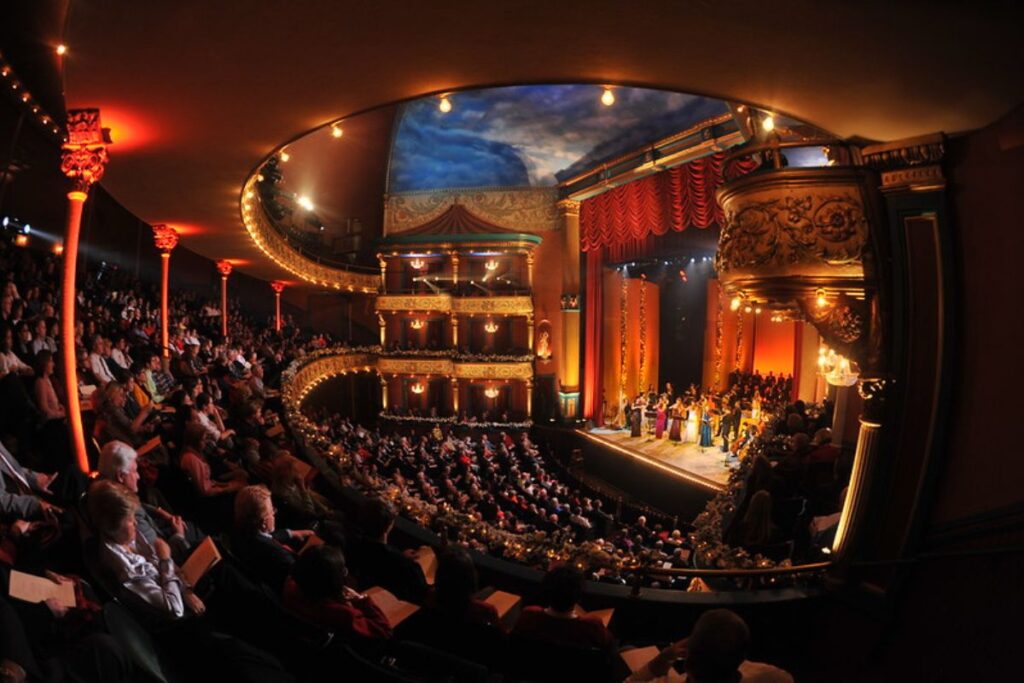
Above: Interior of The Piedmont Grand Opera House in downtown Macon, Georgia. Image courtesy of The Grand Opera House and used with permission from Executive Director Julia Morrison.
The Piedmont Grand Opera House: More Than a Century of Theater, History, and Mystery in Macon
Some historic buildings are admired primarily for their architecture.
Others are remembered for the people who once passed through them.
The Piedmont Grand Opera House in downtown Macon offers both.
For more than a century, audiences have gathered beneath its balconies to experience theater, music, dance, movies, community celebrations, and performances by some of the most recognizable entertainers of their time.
The building has survived changing forms of entertainment, years of decline, the threat of demolition, repeated fundraising campaigns, and the continuing challenges of preserving a historic theater.
It has also accumulated stories that cannot be found on a theater program.
Staff members, performers, visitors, and paranormal investigators have reported unexplained footsteps, voices, moving doors, shadowy figures, and the feeling that someone may still be watching from the theater’s darker spaces.
Documented history and enduring folklore now share the stage at one of Macon’s most treasured cultural landmarks.
The Grand is not a reproduction of a historic theater. It is a working performance venue that has survived, adapted, and continued welcoming audiences for generations.
Before the Grand: Macon’s Early Performance Halls
Macon’s history of public performance spaces reaches back to at least 1832.
A series of early halls attempted to meet the cultural and entertainment needs of a growing city, but many were comparatively short-lived.
By the 1880s, prominent local businessmen believed Macon needed something more ambitious.
Their efforts produced the Academy of Music, which opened in 1884 on the site associated with today’s Piedmont Grand Opera House.
The Academy was an impressive building for its time, distinguished in part by a magnificent rose window. Its opening was considered one of the important social and cultural events of the season.
Historical accounts describe its stage as the largest in the Southeast and place its original seating capacity at approximately 2,400—an extraordinary number in relation to Macon’s population at the time.
Yet the Academy’s period of prominence was surprisingly brief.
Entertainment was changing. Touring companies were becoming more elaborate, audiences expected greater comfort, and the original facility was soon considered inadequate for the productions Macon wanted to attract.
In August 1902, the Academy’s stockholders met to develop plans for modernizing the property.
The resulting project went far beyond an ordinary renovation.
The Academy of Music was demolished, and a seven-story office building was constructed with a much larger theater incorporated behind it.
The Grand Opera House Opens
The greatly expanded Grand Opera House was constructed beginning in 1904 and opened in 1905.
That distinction is important when discussing the theater’s history.
The cultural institution traces its story to the Academy of Music in 1884, but the Grand Opera House that followed was constructed in the early twentieth century.
The new Grand was designed to accommodate the elaborate touring productions traveling across the United States.
Its large stage, balconies, backstage areas, and technical capabilities allowed Macon audiences to experience major theatrical attractions without traveling to Atlanta, New York, or another larger city.
The Grand quickly became one of the region’s leading entertainment destinations.
For audiences in Macon, a night at the Grand was not simply an evening out. It was an opportunity to experience nationally known entertainment inside one of the city’s most impressive public spaces.
Two Important Dates
1884: The Academy of Music opened on the site.
1904–1905: The Academy was replaced by a substantially larger theater incorporated behind a new seven-story office building. The Grand Opera House opened in 1905.
The Grand’s Golden Era
From 1905 through 1934, the Grand welcomed many of the leading performers, touring companies, and popular productions of the period.
The theater’s official history identifies appearances by entertainers including Lillian Russell, Maude Adams, Russian ballerina Anna Pavlova, Harry Houdini, Will Rogers, and the comedy team of George Burns and Gracie Allen.
Other historical accounts connect the Grand with Sarah Bernhardt, Lionel and Ethel Barrymore, Bob Hope, and numerous theatrical and musical personalities.
Maude Adams was celebrated for originating the role of Peter Pan on Broadway.
Anna Pavlova became one of the most famous ballerinas of her era.
Will Rogers brought his distinctive combination of humor, social observation, and American storytelling to the stage.
George Burns and Gracie Allen were building the comedy partnership that would later make them stars of radio, film, and television.
The Grand also hosted traveling productions that were the early twentieth-century equivalent of the Broadway tours audiences attend today.
Vaudeville companies brought comedians, musicians, dancers, novelty acts, and specialty performers together on the same program.
Historical records also show that the theater presented minstrel shows. Those productions were once common in American entertainment, but they relied upon racist caricatures and are now recognized as a painful part of the country’s theatrical history.
A complete account of a historic theater should acknowledge both the artistic achievements presented on its stage and the forms of entertainment that reflected the prejudices of their period.
Live Horses, Chariots, and an Extraordinary Production of Ben-Hur
One of the Grand’s most frequently repeated theatrical stories involves a touring production of Ben-Hur.
In 1908, the production brought live horses and chariots onto the stage.
Stage machinery and moving treadmills helped create the appearance of a chariot race for the audience.
Presenting a production of that scale required substantial stage depth, backstage capacity, technical equipment, and access for scenery, performers, animals, and machinery.
The production demonstrates how ambitious live theater could be before film and television made large-scale spectacle available on a screen.
Harry Houdini and the Grand’s Trapdoors
Magician and escape artist Harry Houdini is another legendary figure connected to the Grand.
According to the theater’s official history, Houdini cut nine openings into the Grand’s stage for his illusions, one of which was preserved.
Other historical accounts describe the Houdini explanation as local theater lore, meaning the exact origin of every opening cannot be established with complete certainty more than a century later.
What is clear is that the Grand’s stage contains trapdoors and retains a physical connection to the age of elaborate touring magic and theatrical illusion.
A surviving trapdoor has continued to be used on occasion in modern performances, including productions of The Nutcracker.
A Stage Built for Illusion
The Grand’s trapdoors are more than an interesting architectural detail.
They offer a physical reminder of the performers, stagehands, technical ingenuity, and theatrical surprises that helped audiences believe in the impossible.
Charlie Chaplin and a Wartime Appearance
During World War I, actor and filmmaker Charlie Chaplin appeared at the Grand in connection with a wartime fundraising effort involving John Philip Sousa’s band.
Chaplin was among the world’s most recognizable entertainers, while Sousa was internationally known for his marches and military-band music.
Their association with the fundraising campaign illustrates how theaters such as the Grand served purposes beyond entertainment.
They also became gathering places for civic campaigns, public celebrations, community causes, and national events.
Movies Transform the Grand
Moving pictures were still a developing form of entertainment when the Grand opened.
As films became longer, more sophisticated, and more affordable to present, they began competing directly with touring theatrical companies.
A film could be transported to a theater and shown repeatedly without the travel, housing, salaries, scenery, animals, and technical requirements of a large touring cast.
At the end of 1935, the Grand Opera House became the Grand Theatre cinema.
Live events did not disappear immediately, but movies became an increasingly important part of the schedule.
The transformation allowed the building to remain useful as audience preferences and the entertainment industry changed.
Macon’s Hollywood Premiere
On February 21, 1945, the Grand hosted an event that recalled the excitement of its earlier theatrical years.
The World War II film God Is My Co-Pilot received its world-premiere screening at the theater.
The film was based on the wartime memoir of Robert L. Scott Jr., a Macon native and military aviator.
Searchlights illuminated the sky, the auditorium was packed, and Hollywood-style excitement came to Mulberry Street.
The occasion is remembered as Macon’s only Hollywood world premiere and one of the most celebrated evenings in the Grand’s cinema history.
Decline and the Threat of Demolition
After World War II, American cities and entertainment habits changed rapidly.
Population shifted toward suburban neighborhoods, and new theaters opened closer to developing residential and commercial areas.
Television brought entertainment directly into people’s homes.
Historic downtown movie palaces across the country struggled to remain financially sustainable.
The Grand’s final movie before closing is reported to have been The Sound of Music in 1965.
By 1966, the deteriorating auditorium was considered unsafe, and demolition appeared increasingly likely.
The building could easily have been cleared to create additional parking.
What happened next became one of Macon’s most important preservation stories.
Macon Decides to Save the Grand
On April 9, 1967, community leaders formed the Macon Arts Council, with saving the Grand among its defining purposes.
The organization later became Macon Arts Alliance.
Preservation required far more than repainting the auditorium.
The roof, heating and air-conditioning systems, electrical service, plumbing, seating, and decorative plaster all required extensive attention.
Renowned Macon architect Ellamae Ellis League played a major role in the restoration work undertaken between 1968 and 1970.
In March 1969, preservation advocate Val Sheridan announced a $200,000 capital campaign. The goal was later increased to $300,000 as the extent of the necessary work became clear.
Fundraising included an elaborate event called the Grand Topper, held at the Macon Coliseum on November 14, 1969.
The black-tie celebration and auction reportedly continued until approximately four o’clock the following morning.
The community had decided that the Grand was worth saving.
Macon Nearly Lost the Grand
The theater survives because residents, preservationists, arts supporters, local government, donors, and community organizations refused to accept demolition as its final act.
The Grand Reopens in 1970
The restored Grand Opera House reopened on Monday, April 6, 1970.
The Atlanta Symphony Orchestra performed under the direction of Robert Shaw for a standing-room-only audience.
The white-and-gold auditorium had been renewed, television crews covered the event, and live performance returned to the historic stage.
The Grand again became a home for concerts, dance schools, student performances, benefit productions, community organizations, and touring attractions.
The restoration was an extraordinary achievement, but reopening the doors did not eliminate the financial demands of maintaining a large historic building.
Over the following decades, the Grand required additional fundraising, repairs, renovations, and public support.
Its survival was not the result of a single rescue.
Each generation has had to decide that the Grand remains important enough to preserve.
Southern Rock Takes the Stage
The Grand’s post-restoration history soon became connected to another chapter of Macon’s musical legacy.
In 1973, the theater provided the setting for performances featured in a nationally televised episode of Don Kirshner’s Rock Concert known as “Saturday Night in Macon.”
The program featured the Allman Brothers Band, Wet Willie, the Marshall Tucker Band, and comedian and musician Martin Mull.
The broadcast carried images and sounds from the historic Macon theater to viewers across the country.
It connected a stage associated with vaudeville, ballet, touring drama, and early twentieth-century stars to the Southern rock movement emerging from Macon in the 1970s.
Mercer University Takes the Helm
In 1995, Mercer University entered into an agreement with Bibb County to manage the Grand.
The building remains publicly owned by Macon-Bibb County and is operated as a performing arts center by Mercer University.
Under Mercer’s management, the Grand has continued presenting professional touring productions while serving local arts organizations, students, musicians, dancers, community groups, and special events.
Its relationship with Mercer has helped connect the theater to the educational and cultural life of the university and the larger Middle Georgia community.
In October 2024, the historic venue became The Piedmont Grand Opera House through a naming partnership between Piedmont Healthcare and Mercer University.
Although the sponsored name is relatively new, it continues the legacy of Macon-Bibb County’s historic Grand Opera House.
Modern Improvements Inside a Historic Theater
Historic preservation does not mean freezing a building at one moment in time.
A working theater must remain safe, comfortable, accessible, and technically capable of presenting modern productions.
A major renovation completed in 2018 was supported by a $5 million allocation from Macon-Bibb County’s 2016 Special Purpose Local Option Sales Tax.
The multiphase project included new seating, carpeting and floor finishes, expanded lobby space, two full bars, and larger, modernized restrooms.
These improvements allowed the building to better support performances, receptions, meetings, and special events while respecting its historic architectural character.
Today, the Piedmont Grand Opera House is a 1,030-seat performing arts center.
Its programming includes nationally touring Broadway productions, concerts, comedy, movies, family programming, holiday events, symphony performances, community productions, and special presentations.
The Grand also makes its lobby and other spaces available for meetings, celebrations, and private events.
History That Remains in Use
The best way to preserve a theater is to keep raising the curtain.
Every production, concert, film, rehearsal, and community event gives the Grand another reason to remain part of Macon’s future.
Julia Morrison Begins a New Chapter
The Grand entered another important chapter in July 2026 when Julia Morrison was promoted to executive director of Mercer University’s Piedmont Grand Opera House and Robins Financial Capitol Theatre.
Her appointment followed six years as Mercer’s director of arts marketing, a position that gave her extensive experience promoting some of the university’s most important cultural institutions.
In that role, Morrison supported the Grand as well as the McEachern Art Center, Tattnall Square Center for the Arts, Townsend School of Music, and Robert McDuffie Center for Strings.
Her promotion therefore represents both new leadership and the continuation of a relationship with the Grand that was already firmly established.
Morrison grew up in the Washington, D.C., area, where an early interest in dance developed into a love of theater.
She earned a Bachelor of Arts in theater from Virginia Tech and a Master of Fine Arts in theater from Towson University.
Before moving to Macon in 2019 to work for Mercer, Morrison accumulated experience across several areas of arts administration, performance, education, publishing, marketing, and community engagement.
She founded Critical Point Theatre, a small ensemble-based performance company in New York City, and worked as program editor for Alvin Ailey American Dance Theater.
Her earlier positions also included outreach and marketing coordinator for Talking Band, teaching artist with Broadway Bound Kids, and publication manager for George Mason University’s College of Visual and Performing Arts.
Together, these experiences gave her a perspective shaped by both the creative side of performance and the practical work required to sustain arts organizations.
Morrison was drawn to Macon by its culture, downtown revitalization, musical and artistic heritage, and Mercer University’s investment in the cultural life of the community.
Her leadership philosophy recognizes that historic theaters are not sustained by ticket sales alone. They require responsible stewardship, community investment, creative programming, sound financial footing, and audiences who feel that the arts belong to them.
As executive director, Morrison has identified preservation and audience development as important priorities.
Her plans include protecting the historic venues Mercer operates downtown while also addressing traditions, expectations, and perceived barriers that may cause some people to believe arts spaces are not intended for them.
That commitment is especially meaningful at a theater whose history stretches across multiple generations.
Preserving the Grand’s building protects its physical past. Developing new and more inclusive audiences helps protect its future.
Recognized as One of Macon’s Young Leaders
In 2026, Macon Magazine selected Julia Morrison for its Five Under 40 Young Leaders recognition.
The honor reflects not only her professional work with Mercer and Macon’s performing arts venues, but also a broad record of community leadership and civic participation.
Read more in Macon Magazine’s profile of Julia Morrison.
Morrison’s community involvement extends well beyond her responsibilities at the two theaters.
She has worked with Macon Magazine, first as photography editor and later as managing editor, and serves as fine arts director for Storytellers Macon.
Her board service has included Macon Pride, Big Brothers Big Sisters of the Heart of Georgia, Friends of Rosa Parks Square, Storytellers Macon, and Macon Little Theatre.
She has also participated in the Macon200 Bicentennial Committee, previously chaired the Downtown Macon Community Association, and is a member of the Macon Rotary Club.
Projects with which she has been involved include the FireStarters Indigenous Film Festival, the From Ocmulgee to Okmulgee gallery exhibition, Heart and Sole Workshop, Broadway Does Cabaret, Macon Art eXplosion, Healing a Haunted House, and the Cherry Bomb zine.
Her work reflects a belief that the arts can create shared experiences at a time when digital media frequently separates people into isolated conversations.
Inside a theater, hundreds of people can gather in one room, listen together, and participate in the same unfolding moment.
That experience is part of what gives historic cultural spaces such as the Grand their continuing importance.
With Morrison at the helm, the Grand’s next chapter centers on stewardship, stronger community investment, broader invitations, and the belief that a historic theater should feel alive and welcoming to the entire community.
Is The Piedmont Grand Opera House Haunted?
A theater with more than a century of history naturally collects stories.
Thousands of performers have waited in its backstage spaces.
Generations of audiences have occupied its seats.
Stagehands have worked above, below, and behind the stage.
Employees have walked its corridors long after audiences departed.
Over the years, people associated with the Grand have reported unexplained experiences.
Stories include footsteps heard in otherwise empty areas, faint voices apparently coming from the stage, doors seeming to move on their own, creaking floorboards without a visible person nearby, sudden changes in temperature, shadowy forms, and the sensation of being watched.
These reports are part of the theater’s folklore.
They are not scientific proof that the building is haunted, and ordinary explanations can sometimes account for sounds and sensations inside a large historic structure.
Old buildings expand and contract.
Air moves through corridors, stairwells, stage openings, and ventilation systems.
Mechanical equipment activates, and sound travels in unexpected ways through theaters designed around acoustics.
But those explanations have not prevented the Grand’s ghost stories from becoming part of its enduring mystery.
Randell Widner: The Grand’s Best-Known Ghost Story
One name firmly connected to the Grand’s history and paranormal folklore is Randell Widner.
Widner served as the theater’s executive director in the early 1970s and died inside the Grand in 1971.
Published accounts describe him as a man who cared deeply about the theater and devoted himself to its work.
In the years following his death, employees and visitors began associating unexplained experiences inside the building with his presence.
Stories attributed to Randell include doors that appear to open or close without assistance, unexplained footsteps, unusual sounds, and sightings of a shadowy or humanlike figure.
The theater has even maintained a seat in his memory.
The documented facts provide the foundation for the story: Randell Widner worked at the Grand, served as its executive director, and died inside the theater.
Whether his presence remains there belongs to the realm of personal experience, local legend, and paranormal belief.
Randell’s story endures because it connects the Grand’s verifiable human history with the unexplained experiences reported by people who have entered the theater after the audience has gone home.
History, Legend, and Responsible Storytelling
Randell Widner’s work at the Grand and his death inside the theater are part of its documented history.
Claims that his spirit remains in the building are part of personal experience, paranormal investigation, and local folklore.
Macon Beyond Investigates The Piedmont Grand Opera House
Macon Beyond is a destination storytelling series created through a partnership involving Visit Macon and actor and producer Carrie Genzel.
The series explores historic Macon locations through their documented history, the people connected with them, and the unexplained stories that continue to surround them.
The Piedmont Grand Opera House episode features host Carrie Genzel, empath and medium Morrighan Lynne, and investigator Jonathan Morgan.
The team entered the theater to examine reports of unexplained activity and investigate whether the building might contain something beyond the memories preserved in its walls.
The episode takes viewers into areas many audience members may never closely examine, including the stage, balconies, backstage spaces, and upper portions of the theater.
During the investigation, team members reported temperature changes, uncomfortable sensations, apparent responses through their equipment, and the impression that something was concealing itself in an upper area above the stage.
When the investigators addressed questions to Randell, their equipment produced responses immediately following several of those questions.
The team interpreted one of the strongest responses as an affirmative answer when they asked whether the presence was Randell.
Additional activity occurred when they asked whether he could move freely into and out of the building.
The exchange became one of the episode’s most memorable moments.
Although the equipment registered responses during the investigation, the results do not scientifically establish that the responses came from Randell’s spirit.
Viewers may interpret the activity as paranormal communication, environmental interference, coincidence, or an unanswered mystery.
The episode succeeds in another important way regardless of that conclusion.
It encourages viewers to look more closely at the Grand’s architecture, hidden spaces, documented history, and generations of human experience.
Watch the complete episode through Macon Beyond: The Piedmont Grand Opera House.
The Piedmont Grand Opera House Today
The Grand is not merely remembered as a theater.
It remains one.
As of 2026, it continues to present Broadway national tours, concerts, symphony performances, films, comedy, family programming, educational events, community productions, and special presentations.
The theater identifies itself as Central Georgia’s only presenter of professional, nationally touring Broadway productions.
Its announced 2026–2027 Broadway season includes Mystic Pizza, The Wiz, and Hadestown.
Its broader calendar includes musical events, film screenings, children’s productions, holiday traditions, and performances connected to Macon’s musical heritage.
Programming changes throughout the year, so visitors should review the theater’s official calendar for current productions, dates, ticket availability, and performance information.
More than 120 years after the Grand Opera House opened, audiences are still taking their seats and waiting for the lights to dim.
A Landmark Worth Experiencing
Reading about the Grand’s history can explain why the building matters.
Attending a production allows you to experience it.
Walk beneath the historic facade on Mulberry Street.
Enter the renewed lobby.
Take a seat beneath the balconies.
Look toward a stage that has welcomed magicians, actors, dancers, comedians, musicians, touring companies, community performers, and nationally known artists.
Then watch as that same stage becomes part of another story.
The Piedmont Grand Opera House demonstrates what historic preservation can accomplish when a community refuses to surrender an important building.
It also shows why preservation must be followed by continued use, responsible stewardship, community investment, and a sincere invitation for new audiences to participate.
The Grand survived because Macon saved it. It continues to thrive because performers keep returning, audiences keep gathering, and new generations continue believing in the value of a shared experience.
Plan an Evening at the Grand
Visit the historic Piedmont Grand Opera House at 651 Mulberry Street in downtown Macon and enjoy one of its Broadway productions, concerts, films, community programs, or special events.
Explore current productions and ticket information through the official Piedmont Grand Opera House event calendar.
New Listings: Macon Georgia
Sign up: Market Reports
Learn More: About JoJo
View More: Macon Listings
Featured: Macon Magazine
JoJo's Properties: JoJo's Listings Hub
Contact Me: Sell Smart with JoJo™