
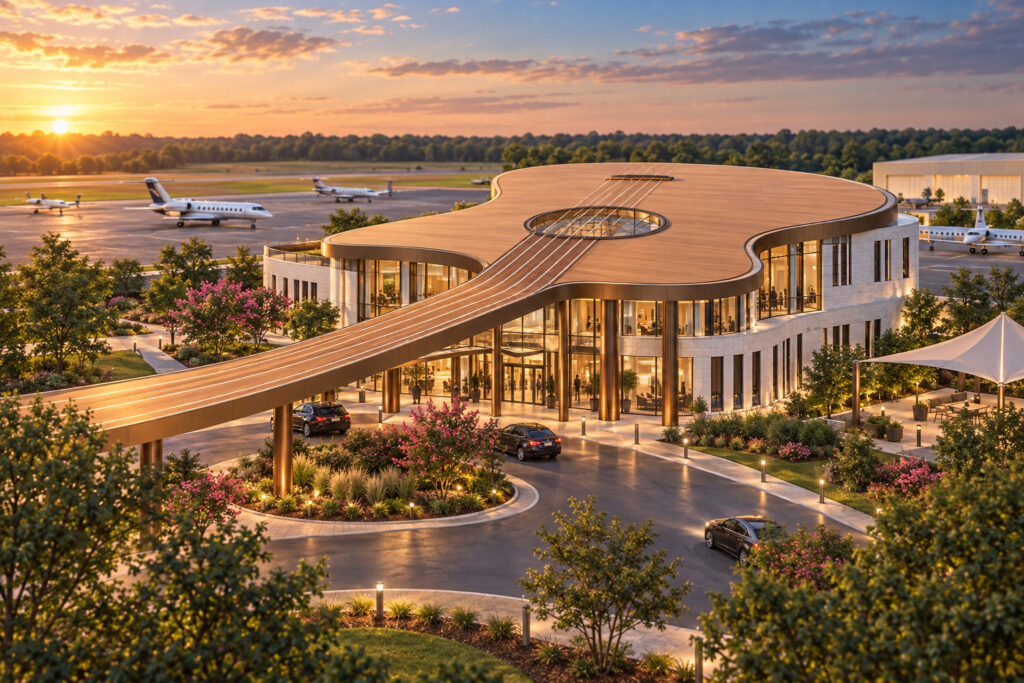
Above: Conceptual artistic rendering of a guitar-shaped airport terminal celebrating Macon’s legendary musical heritage. This image is illustrative and does not represent an existing or officially proposed design.
A Guitar-Shaped Gateway Is Rising in Macon, Georgia
When visitors arrive in a city, their first impression can begin long before they reach a hotel, restaurant, historic district, or local attraction. Sometimes, it begins at the airport, and Macon’s new executive airport terminal is being designed to make that first impression unforgettable.
Macon-Bibb County is preparing to give private and corporate aviation visitors an arrival experience unlike almost anything else in the country.
A new guitar-shaped executive terminal is rising at Middle Georgia Regional Airport.
Its architecture will immediately introduce arriving visitors to a community where music is not simply part of the past.
Music is part of Macon’s identity, architecture, tourism, creative community, and plans for the future.
The new executive terminal is designed to do more than serve aircraft and passengers. It will tell visitors something about Macon from the moment they arrive.
Construction Reaches an Important Milestone
On August 31, 2026, Macon-Bibb County, Middle Georgia Regional Airport, Sheridan Construction, and project partners gathered for a topping out ceremony at the airport.
A topping out ceremony marks the placement of a building’s final or highest structural beam.
It recognizes the contractors, construction crews, designers, and partners responsible for bringing a project to that stage.
For Macon’s new executive terminal, the ceremony represented a major step forward in a project expected to be completed in May 2027.
Construction will continue with exterior framing and finishes, glass, roofing, a skylight, interior finishes, and the completion of the building’s monumental staircase and other architectural features.
When complete, the terminal will become a new point of arrival for private and corporate aviation passengers coming to Macon and Middle Georgia.
Why Is the New Macon Airport Terminal Shaped Like a Guitar?
The approximately 15,000-square-foot building is designed in the shape of a guitar, with additional architectural angles resembling piano keys.
The guitar’s neck will be represented by a canopy extending toward the parking area.
Lighting is expected to make the building’s distinctive form visible from the air and recognizable to people approaching the terminal.
The design is not based on a random object selected simply to attract attention.
The guitar has a genuine connection to Macon’s history.
Macon’s musical legacy includes artists and groups such as Otis Redding, Little Richard, the Allman Brothers Band, and numerous other performers who influenced soul, rock and roll, Southern rock, gospel, blues, and American popular music.
The city is also home to historic music destinations that include the Otis Redding Foundation, The Big House Museum, Capricorn Sound Studios, the Douglass Theatre, Grant’s Lounge, and the historic Grand Opera House.
The shape of the terminal creates an immediate connection between the airport and the city it serves.
A First Impression That Belongs to Macon
Visitors will not simply walk into a new executive terminal.
They will enter a building designed to introduce Macon’s musical heritage before they even leave the airport.
What Will Be Inside the Executive Terminal?
The new HighNote Aviation Executive Terminal will become the home of the airport’s Fixed Base Operator, commonly called an FBO.
An FBO provides services to private and corporate aircraft, pilots, passengers, and aviation businesses.
Depending on the facility, those services may include aircraft fueling, flight assistance, ground transportation, hangaring, passenger support, and other services required by general and corporate aviation.
Previously announced plans for Macon’s new terminal include:
- A welcoming FBO lobby
- A dedicated flight-planning area
- A conference room for aviation and business meetings
- Office space
- A pilot store
- Space for a flight school
- A restaurant and bar
- An outdoor patio overlooking the airfield
- A second-floor balcony with panoramic airport views
- An event lawn for community gatherings and special events
The restaurant, patio, balcony, and event areas could also give people who are not flying a reason to experience the terminal.
This helps explain why airport leaders have described it as a community project rather than simply an airport project.
Are There Other Guitar-Shaped Buildings in the United States?
Buildings designed to resemble familiar objects are sometimes described as novelty, programmatic, or mimetic architecture.
The building itself becomes a symbol of the business, destination, culture, or activity it represents.
Musical-instrument-shaped buildings are uncommon, but there have been a few notable American examples.
The Guitar Hotel in Hollywood, Florida
One of the best-known examples is the Guitar Hotel at Seminole Hard Rock Hotel & Casino in Hollywood, Florida.
The approximately 450-foot tower opened in 2019 and was designed to resemble guitars placed back-to-back. Lights projecting into the sky create the appearance of illuminated guitar strings extending above the building.
The hotel has become a recognizable part of the South Florida skyline and a destination partly because of its architecture.
The Guitar-Shaped House in Fayetteville, Georgia
Georgia has also been home to a privately constructed guitar-shaped residence in Fayetteville.
The house was built over a period of years by country musician Elvis Carden. Its unusual design includes a skylight positioned to resemble the sound hole of an acoustic guitar.
The residence reportedly became recognizable enough from the air to serve as a visual landmark for some pilots.
The Former Grand Guitar in Bristol, Tennessee
Bristol, Tennessee, once had a guitar-shaped building known as the Grand Guitar.
Constructed in the early 1980s, the building housed music-related attractions that included a recording studio, radio station, gift shop, and small musical-instrument museum.
The Grand Guitar was eventually demolished, but it remains part of the history of America’s roadside and music-inspired architecture.
A Rare Kind of Working Public Building
Macon’s terminal will be more than a sculpture, private residence, hotel attraction, or piece of roadside architecture.
It will be a working aviation facility designed to welcome pilots, business travelers, private passengers, and community visitors.
A Building Designed by Macon’s Identity
What may distinguish Macon’s project from other guitar-shaped buildings is how naturally the design fits the place where it is being built.
A guitar-shaped terminal makes sense in Macon.
The city helped shape the development of soul, Southern rock, gospel, rhythm and blues, and rock and roll.
Its musical history lives in recording studios, theaters, museums, churches, clubs, restaurants, historic homes, public art, and the stories of the people who created music here.
The new terminal will bring that identity into a piece of modern public architecture.
It connects the Macon of today with the artists, musicians, architecture, and creative traditions that helped make the city known.
Music Is Only Part of Macon’s Architectural Story
Visitors who arrive through the new executive terminal will encounter a community with architectural history extending far beyond the airport.
Macon offers grand historic homes, churches, theaters, commercial buildings, industrial structures, and neighborhoods that reflect different periods of the city’s development.
The Hay House is among Macon’s most recognizable architectural landmarks, with its Italian Renaissance Revival design, central cupola, intricate interiors, and commanding presence along Georgia Avenue.
The Cannonball House presents another part of the city’s story through Greek Revival architecture and its connection to the Civil War.
Macon’s Terminal Station, designed by architect Alfred T. Fellheimer, recalls an era when passenger rail connected Macon with destinations throughout the region and country.
Historic churches, the Grand Opera House, the Douglass Theatre, the Macon City Auditorium, and downtown commercial buildings further demonstrate the variety of architecture found throughout the community.
Entire neighborhoods also contribute to Macon’s architectural character.
In areas such as Intown Macon, Vineville, and Shirley Hills, visitors and prospective homebuyers may encounter historic residences displaying Greek Revival, Victorian, Tudor, Craftsman, Colonial Revival, and other architectural influences.
Architecture You Can Experience
In Macon, architecture is not confined to a museum exhibit.
It can be experienced in historic homes, neighborhoods, theaters, churches, public buildings, and soon, in a guitar-shaped airport terminal.
The Arts Continue to Thrive in Macon Today
Macon’s artistic story did not end with the legendary musicians and performers associated with the city.
The arts continue to be created, performed, taught, displayed, and celebrated throughout the community.
Live music can still be heard in historic venues and contemporary gathering places.
Local and visiting performers appear at theaters, festivals, clubs, concert venues, and community events.
Visual art is represented through galleries, museums, murals, public art, exhibitions, and the work of individual artists.
The Piedmont Grand Opera House continues to present performing arts in a historic setting.
The Douglass Theatre remains an important cultural and performance venue.
Capricorn Sound Studios connects visitors and working musicians with Macon’s recording history.
The Museum of Arts and Sciences brings art, science, education, and exhibitions together for residents and visitors.
Organizations, educational institutions, theaters, galleries, festivals, and independent creators continue to contribute to Macon’s modern cultural life.
Macon preserves its artistic history while continuing to create new art, music, performances, and cultural experiences.
More Reasons to Place Macon on Your List of Cities to Visit
The guitar-shaped terminal may eventually become an attraction in its own right.
But it will also serve as a fitting introduction to everything visitors can experience after leaving the airport.
A trip to Macon can include:
- Exploring the city’s musical heritage
- Visiting historic homes and architectural landmarks
- Touring museums and cultural attractions
- Experiencing live music and performing arts
- Viewing murals, galleries, exhibitions, and public art
- Walking through historic neighborhoods
- Visiting Ocmulgee Mounds National Historical Park
- Enjoying locally owned restaurants and gathering places
- Attending festivals, concerts, and community events
- Experiencing Macon’s parks, riverfront, and natural surroundings
Macon is centrally located within Georgia, but its identity is entirely its own.
Its appeal comes from the combination of history and creativity.
Architecture and music.
Museums and live performances.
Ancient cultural sites and new development.
Established neighborhoods and evolving destinations.
If you are building a list of American cities to experience for their culture, architecture, music, and sense of place, Macon deserves consideration.
Part of a Larger Investment in Macon’s Airport
The executive terminal is not the only improvement underway at Middle Georgia Regional Airport.
Macon-Bibb County assumed management of the airport’s FBO operations in 2023, allowing the airport to become more directly involved with private and corporate aviation customers.
Construction is also underway on a 600-foot extension of Runway 5-23.
When completed, the runway is expected to increase from 6,501 feet to 7,101 feet.
The extension is intended to help larger aircraft operate more efficiently and improve the airport’s ability to accommodate corporate, commercial, and general aviation activity.
Macon-Bibb County accepted an FAA Airport Infrastructure Grant of up to approximately $2.62 million for the runway project in 2026. Additional state funding has been accepted for paving and lighting associated with the extension.
Middle Georgia Regional Airport also currently promotes nonstop Contour Airlines service from Macon to Baltimore/Washington International Airport and Fort Lauderdale.
Together, the executive terminal, runway improvements, aviation services, and passenger connections represent a broader investment in Macon’s transportation and economic infrastructure.
More Than One New Building
The guitar-shaped terminal is the most visually distinctive part of the airport’s current development story.
The runway extension, aviation services, business opportunities, and passenger connections help reveal the larger economic-development picture.
What Could This Mean for Macon Real Estate?
No single airport building can guarantee that property values will increase or that more homes will sell.
Real estate markets are influenced by employment, population trends, interest rates, available housing, neighborhood conditions, business investment, and many other factors.
However, transportation and economic-development projects can contribute to the conditions that support real estate demand over time.
A more capable airport may help Macon serve business travelers, corporate aviation customers, visitors, investors, and companies considering opportunities in Middle Georgia.
When a community becomes easier to reach and makes a strong impression on visitors, it may also become easier for people to picture themselves doing business, investing, or living there.
Airport-area growth may create opportunities involving aviation, commercial property, industrial development, hospitality, restaurants, services, and workforce housing.
The effects will not necessarily be immediate or equal in every neighborhood.
Nevertheless, sustained infrastructure investment can become part of the broader story buyers and investors consider when evaluating a community’s direction.
For Macon homeowners, buyers, and real estate investors, the most important point may be that the city continues to invest in assets intended to support tourism, connectivity, business recruitment, and long-term growth.
A New Welcome to Macon
When the HighNote Aviation Executive Terminal opens, visitors will arrive through a building that could not easily be mistaken for an airport in another city.
Its design will say something about Macon before anyone delivers a welcome speech or hands a visitor a travel guide.
It will point to the city’s musical past.
Its creative present.
And its plans for the future.
Beyond the airport, visitors can discover historic architecture, influential music sites, ancient cultural history, museums, performing arts, public art, restaurants, neighborhoods, and a community continuing to evolve.
The guitar-shaped terminal will not create Macon’s identity. It will help introduce visitors to an identity the city has been building for generations.
Considering a Move to Macon or Middle Georgia?
Visiting Macon may begin with the music, architecture, history, arts, food, or festivals.
For some visitors, it may lead to a deeper interest in the community and what it could be like to live here.
Macon and Middle Georgia offer a variety of homes, neighborhoods, architectural styles, and lifestyles.
Understanding the local real estate market requires more than reviewing general statistics or citywide averages.
Conditions can differ by neighborhood, property type, price range, condition, and the specific features buyers are seeking.
Joanna “JoJo” Jones helps buyers and sellers understand Macon and Middle Georgia real estate with local knowledge, professional guidance, and careful attention to the qualities that make each property and neighborhood distinctive.
Whether you are relocating, searching for a historic home, considering a move within Middle Georgia, or preparing to sell, a conversation with an experienced local real estate professional can help you understand your options.
Discover Macon—and the Possibility of Calling It Home
Talk with JoJo about Macon and Middle Georgia neighborhoods, homes, market conditions, and the communities that may fit the way you want to live.
Real estate conditions, property values, economic-development results, buyer demand, and neighborhood trends can change and vary by location and property. This article is provided for general informational purposes and should not be interpreted as a guarantee that the executive terminal, airport improvements, tourism, or other development will increase the value or marketability of any particular property.

New Listings: Macon Georgia
Sign up: Market Reports
Learn More: About JoJo
View More: Macon Listings
Featured: Macon Magazine
JoJo's Properties: JoJo's Listings Hub
Contact Me: Sell Smart with JoJo™